
Rules Reference
This document is intended as the definitive source for rules information for the Emerald Legacy, the fan continuation of Fantasy Flight Games' Legend of the 5 Rings LCG. The majority of this guide consists of the glossary, which provides an alphabetical listing of terms and situations a player might encounter during a game. This section should be the first destination for players who have a rules question. The latter part of this guide contains two appendices. The first appendix provides detailed timing diagrams that illustrate the structure of an entire game round, as well as how to handle each game step presented in those diagrams. The second provides a detailed anatomy of each card type.
The Emerald Rule
If the text of this Rules Reference directly contradicts the text of FFG’s Rules Reference, the Emerald Legacy Rules Reference takes precedence. Changes to FFG’s Rules Reference are shown in bold. Changes to the last version of the Emerald Legacy RRG are written in green.
If the text of a card directly contradicts the text of this Rules Reference, the text of the card takes precedence.
Glossary
The following is an alphabetical list of entries for game rules, terms, and situations that may occur during play.
Ability
An ability is the special game text that a card contributes to the game. Card abilities fall into one of the following types: actions, constant abilities, interrupts, keywords, and reactions. Some interrupt and reaction abilities are also forced.
-
Card abilities only interact with, and can only target, cards that are in play, unless the ability specifically refers to an out-of-play area or element. Card abilities on characters, attachments, holdings, strongholds, and provinces can only be initiated or affect the game while they are in play unless the ability specifically refers to being used from an out-of-play area, or require that the card be out of play for the ability to resolve. Event cards and role cards implicitly interact with the game from an out-of-play area, as established by the rules of their card types.
-
The application or initiation of the following types of abilities is mandatory: constant abilities, forced interrupt abilities, and forced reaction abilities.
-
The initiation of any keyword which uses the word "may" in its keyword description is optional. The application of all other keywords is mandatory.
-
The initiation of action, interrupt, and reaction abilities is optional. The word "may" also incorporates a player option into the resolution of an ability. The player who controls the card on which an optional ability exists determines whether or not he or she wishes to use that ability at the appropriate time.
-
An ability prefaced by a bold-face timing trigger followed by a colon is referred to as a "triggered ability."
-
The controller of the card from which an ability is resolving makes all decisions required by that ability’s resolution unless another player is specified by the ability’s text.
Action, Action Ability
An action ability is a triggered card ability that contains the boldface "Action:" precursor. An action ability may be triggered by its controller during any action window (see Appendix I: Timing and Gameplay).
-
Unless otherwise noted by the ability, each action ability may be initiated only once each round.
-
An action that has been initiated must be resolved before the next action can be initiated.
Related: Ability, Triggered Abilities
Active Player
In some phases, the game creates an active player, who is granted permission to perform a specified task.
-
During the dynasty phase, the active player is the player who is permitted to play character cards from his or her provinces or initiate an action ability. The status of active player alternates between players in this phase until all players have passed.
-
During the conflict phase, the active player is the player with the opportunity to initiate a conflict, or the player who is resolving a conflict he or she has initiated.
Additional Conflicts
Some card abilities allow a player to declare an additional conflict during the conflict phase. The additional conflict created by such an effect is in addition to a player’s two normal conflict opportunities. It does not replace the normal or conflict opportunity that player has each conflict phase.
Additional Cost
Some card abilities require an additional cost to be played to play a card, trigger an ability, or perform a framework step. If the additional cost cannot be paid, the game action cannot be initiated.
-
All costs are paid simultaneously, including additional ones.
Related: Cost
Affinity
Affinity is a special condition unique to each player. It is defined in combination with a trait, some common formats it can be found on cards are: “with Trait affinity”, or “if you have Trait affinity”. It is most commonly combined with the five elemental traits.
A player has affinity to a trait while they control any character with that trait.
Related: Traits
Against
During a conflict, the attacking player and the defending player are considered to be taking part in the conflict against each other.
Ancestral
Ancestral is a keyword ability that appears on attachments. If the card or game element to which an ancestral attachment is attached leaves play, the ancestral attachment is returned to its owner’s hand instead of being discarded.
Attachment Cards
Attachment cards represent weapons, armor, items, skills, spells, conditions, and titles. An attachment card enters play ready and attached to another card or game element, and remains in play unless it is removed by an ability, or unless the attached card leaves play.
-
An attachment cannot enter play if there is no eligible card or game element to which it can attach. A card or game element becomes ineligible for a player’s attachment if a copy of that attachment controlled by the same player is already attached to it.
Example: Otomo Courtier is the only character in play and has Karolina’s Ornate Fan attached to it. Karolina has another copy of Ornate Fan in hand, but she is not allowed to play it, as there are no eligible targets for it. She cannot choose to play Ornate Fan on the Otomo Courtier and discard the other copy. Karolina’s opponent Martin, however, can play his copy of Ornate Fan on the Otomo Courtier, as the two copies of Ornate Fan would be controlled by different players. -
An attachment can only attach to a character in play, unless otherwise specified by the attachment’s text.
-
There is no limit on the number of attachments that may be attached to a card or game element. However, only one copy of an attachment (by name) per player can be attached to a card or game element at the same time.
-
If a situation arises where a card or game element has multiple copies of an attachment controlled by the same player attached to it, its controller (or the First Player, if there is no controller) must immediately discard copies of that attachment until there is only one copy attached.
-
If the card to which an attachment is attached leaves play, simultaneously discard the attachment.
-
If a situation arises in which an attachment is not legally attached, discard the attachment.
-
An attachment a player controls remains under his or her control even if the card or game element to which it is attached is under an opponent’s control.
-
An attachment card bows and readies independently of the card to which it is attached.
-
If an attachment has skill modifiers, those modifiers apply to the skill of the attached character. Such modifiers apply to the character even while the attachment is bowed.
-
Attachments on a province are not considered to be in that province.
-
If a character card is in play as an attachment, the skill values on that character-as-attachment are not treated as skill modifiers (as they lack the "+" or "-" symbol before the value) for the character to which the card is attached.
-
If an attachment has a limit (for example "Limit 1 Battlefield attachment per province"), that indicates that only one instance of a particular subset of cards can be attached to the same card or game element. If a second card of that subset becomes attached to the card or game element, the previously attached card is discarded as the limit has been surpassed.
For attachment card anatomy, see "Appendix II: Card Anatomy".
Attacker, Attacking Character, Attacking Player
The term "attacking character" refers to a character that is participating in a conflict on the side of the player who initiated the conflict. The term "attacker" is also used as shorthand for "attacking character."
The term "attacking player" refers to the player that initiated the conflict that is currently resolving.
Base Value
The value of a quantity before other modifiers are applied. For most quantities, it is also the printed value.
Bid Value
If the value of an honor bid is modified, resolve that bid as if the modified value is that player’s bid. The value of a bid may exceed five (the highest number on the honor dial), or may be reduced to zero.
-
When the value of an honor bid is modified, the setting on the dial is not itself adjusted.
-
If a card ability references a player’s honor bid, the ability is referencing the current setting on the player’s honor dial.
Blank
If an ability causes a card’s printed text box to be considered "blank", that text box is treated as if it did not have any of its printed Traits or card abilities. Text gained from another source is not blanked.
Breaking a Province, Broken Province
If the attacking player wins a conflict with a total skill difference (between the attacking player and the defending player) equal to or greater than the defense strength of the attacked province, the province breaks.
-
Rotate a province card 180 degrees or discard a province token to indicate the province is broken.
-
When a province is broken, the attacking player has the option of discarding any dynasty cards in that province. If this option is taken, the province is refilled facedown.
-
Ability text on a broken province card is not active.
-
Dynasty cards may still be played from broken provinces, and broken provinces still refill following the standard game rules.
-
If three of a player’s non-stronghold provinces are broken, that player’s stronghold becomes an eligible province against which attacks may be made. If a player’s stronghold province is broken, that player loses the game.
-
If a player does not have a stronghold province, they lose the game when all of their provinces are broken.
-
-
If a province breaks for any reason other than through standard conflict resolution, the opponent of the player who controls that province is considered to have broken the province.
-
If a player has multiple opponents, each of those players is considered to have broken the province.
-
Bow, Bowed
Cards often bow after participating in a conflict, to use card abilities, or as the result of card or game effects. When a card is bowed, it is rotated 90 degrees. A card in this latter state is considered bowed.
-
A bowed card cannot bow again until it is ready. Cards are typically readied by a game step or card ability.
-
During conflicts, bowed characters do not contribute their skill.
-
A bowed attachment with skill modifiers still modifies the skill of the attached character.
-
A card ability on a bowed card is active and can still engage with the game state. However, if a bowed card must bow as part of its cost to trigger an ability, it cannot bow again until it is readied, so the ability could not be triggered.
Cancel
Some card abilities can "cancel" other card or game effects. Cancel abilities interrupt the initiation of an effect, and prevent the effect from initiating. Because of this, cancel abilities have timing priority over all other interrupts to the effect that is attempting to initiate.
-
If an effect is canceled, that effect is no longer imminent, and further interrupts (including cancels) cannot be initiated in reference to the canceled effect.
-
If the effects of an ability are canceled, the ability is still considered to have been used, and any costs have still been paid.
-
If the effects of an event card are canceled, the card is still considered to have been played, and it is still placed in its owner’s discard pile.
-
If a ring effect that is resolving for winning a conflict is canceled, the ring is still claimed.
Cannot
The word "cannot" is absolute, and cannot be countermanded by other abilities or effects.
Cards under another card
Some card effects like Kaiu Shihobu (Defenders of Rokugan 10), Togashi Tsurumi (Through the Mists 13) or Stowaway (Through the Mists 50) place cards under another card. These cards are out of play and can only be interacted with by effects that explicitly state that.
-
If a card leaves play, any cards that have been put under it this way are removed from the game, unless otherwise specified by the effect that put them there.
-
This does not apply to attachments, only to cards that are explicitly placed under/underneath a card by a card effect.
Card types
The game’s card types are: character, attachment, holding, event, province, stronghold, and role. Each of these card types, with a detailed card anatomy, is presented in "Appendix II: Card Anatomy".
-
If an ability causes a card to change its card type, the card loses all other card types it might possess, and functions as would any card of the new card type.
Challenge
Some card abilities use the word "challenge" to begin the process of resolving a duel between two characters. For the rules on how to resolve a duel, see "Duel Timing".
Character Cards
Character cards represent the bushi, courtiers, shugenja, monks, shinobi, armies, creatures, and other personalities and groups one might encounter in Rokugan.
-Characters played from a player’s provinces can only be played during the dynasty phase. Characters played from a player’s hand can only be played during any action window outside the dynasty phase.
-
Character cards generally enter play ready and in a player’s home area, and remain in play unless removed by an ability or game step.
-
When a player plays a character from his or her hand during a conflict, the player has the option to play it directly into the conflict, ready and participating on his or her side.
-
When a player plays a character in a team conquest format game, that player chooses to either play it under their own control or under the control of a teammate. Once played, control cannot be exchanged except by card effects. Fate is placed on the character from the fate pool of the player playing the character, regardless of which player controls it.
For character card anatomy, see "Appendix II: Card Anatomy".
Choose
The word "choose" indicates that one or more targets must be chosen in order to resolve an ability.
Related: Target
Clan
There are 7 clans in the core set, as depicted in the chart below.
A player’s stronghold card signals which clan a player has chosen as the primary clan for his or her deck. The clans and their associated symbols are listed below.
-
An "in-clan" card bears a clan symbol that matches the clan symbol on its controller’s stronghold card.
-
An "out-of-clan" card bears one or more clan symbols that do not match the clan symbol on its controller’s stronghold card, and does not bear a clan symbol that matches the clan symbol on its controller’s stronghold card.
-
If a player does not have a stronghold card, "in-clan" and "out-of-clan" determination is defined by the clan selected during deckbuilding to be that player’s primary clan.
-
Related: Deckbuilding
| Clan | In Text | On Card |
|---|---|---|
Crab Clan |
|

|
Crane Clan |
|

|
Dragon Clan |
|

|
Lion Clan |
|

|
Phoenix Clan |
|

|
Scorpion Clan |
|

|
Unicorn Clan |
|

|
Composure
Composure is a variable keyword ability. A card with this keyword gains an additional ability while its controller’s honor bid is lower than that of one of his or her opponents.
-
Most uses of the composure keyword grant a constant ability that modifies a character’s skills or glory. Some may grant triggered abilities that can only be used while a player has composure.
-
"You have composure" is the phrase indicating that a player’s composure keyword is active. It is used in reminder text to indicate that a player’s card has the ability granted by composure while their honor bid is lower than an opponent’s.
Conflict
During the conflict phase, each player has two opportunities to declare a conflict against an opponent. For the rules on how to resolve conflicts, see Framework Details.
Conflict Action, Triggered Conflict Ability
If a triggered ability is preceded by the modifier "Conflict", that ability can only be triggered during a conflict. It functions as a shorthand for the following triggering conditions:
-
On events, strongholds and holdings "Conflict X:" replaces "X: During a conflict, …"
-
On provinces "Conflict X:" replaces "X: During a conflict at this province, …"
-
On characters "Conflict X:" replaces "X: During a conflict in which this character is participating, …"
-
On attachments "Conflict X:" replaces "X: During a conflict in which attached character is participating, …"
-
If a Triggered Conflict Ability can only be triggered in a conflict of a specific type, the boldface timing command is preceded by the or symbols, respectively.
Example: A character has the ability "Conflict Action: Pay 1 fate - ready this character." This is equivalent to "Action: During a conflict in which this character is participating, pay 1 fate - ready this character." -
If a card’s remaining triggering conditions directly contradict parts of this replacement, the card’s text takes precedence.
Example: The attachment Stinger (Through the Mists 34) has the ability "Conflict Action: While this card is in your hand, choose an attacking character and lose 1 honor - …". Because Stinger has to be in your hand in order to trigger its ability, it does not have an attached character. In this case, the "Conflict Action:" is interpreted as "Action: During a conflict, …" instead of "Action: During a conflict in which attached character is participating, …" -
If a player is instructed to resolve a Triggered Conflict Ability on a character, the triggering conditions above must still be met. This means that the character must be participating in a conflict of the right type (if specified).
Conflicts at Multiple Provinces
When a conflict is at multiple provinces, each of those provinces is the "attacked province" and abilities that interact with the conflict being at those provinces can be used.
During the resolution of a conflict at multiple provinces, compare the attacking player’s excess skill against the strength of each attacked province separately to determine if that province is broken.
Any card ability that interacts with "the attacked province" interacts with one (not both) of those provinces.
Constant Abilities
A constant ability is any non-keyword ability whose text contains no boldface timing trigger defining its ability type. A constant ability becomes active as soon as its card enters play and remains active while the card is in play.
-
Some constant abilities continuously seek a specific condition (denoted by words such as "during," "if," or "while"). The effects of such abilities are active any time the specified condition is met.
-
If multiple instances of the same constant ability are in play, each instance affects the game state independently.
-
If a constant ability would cause a card to leave play, interrupt abilities cannot be used to replace or prevent that constant ability.
Control and Ownership
A card’s owner is the player who included the card as a part of his or her deck (i.e., dynasty deck, conflict deck, provinces, stronghold, role) at the beginning of the game.
-
By default, cards enter play under their owner’s control. Some abilities may cause cards to change control during a game.
-
A player controls the cards in his or her out-of-play game areas (such as the hand, the dynasty and conflict decks, and the dynasty and conflict discard piles).
-
When a card would enter an out-of-play area of a player who does not own the card, the card is placed in its owner’s equivalent out-of-play area instead. (For all associated card ability and framework effect purposes, the card is considered to have entered that opponent’s out-of-play area, and only the physical placement of the card is adjusted.)
-
If a participating character changes control during a conflict, it is considered participating in the same conflict on the side of its new controller.
-
When a character changes control while it is in play, it remains in the same state as it was before (i.e., bowed or ready, participating or at home, etc.), and is now under the new player’s control.
-
Attachments on a card that changes control do not themselves change control.
-
Unless a duration is specified, a control change persists as long as the card remains in play.
Copy (of a card)
A copy of a card is defined by title: any other card that shares the same title is considered a copy, regardless of card type, text, deck of origin, artwork, or any other characteristic(s) of the card(s).
-
A card is considered to be a copy of itself, as it shares its own title.
Copy (of a character)
Some card abilities may cause a character to become a copy of another character. When that happens, the character that is changing loses its name, cost, base skills and glory, traits, clan affiliation, and ability text. It gains the name, cost, base skills and glory, traits, clan affiliation, and ability text of the copied character for the duration indicated by the card ability.
-
Cards that refer to a character’s printed text (skills, traits, abilities, etc.) still refer to the text physically printed on the card.
-
When a character becomes a copy of another character, only the base skills and printed characteristics are copied. If the character that is changing gains characteristics (such as traits or ability text) from another non-copy card ability (such as an event or attachment) then those characteristics are not lost.
-
A character can only become a copy of a unique character if its owner and/or controller does not also own or control a copy (by title) of that unique character.
-
Becoming a copy of another character replaces the character’s base skills and glory. This is not applying a modifier (dashes can be replaced).
-
A character cannot become a copy of another character if both characters have the same title.
Corrupted
Corrupted is a keyword ability. A character with the corrupted keyword enters play tainted. Abilities cannot be triggered from a corrupted character receiving the tainted status token from this keyword, as that card enters play already with that status.
Related: Tainted, Tainted Status Token, Status Token
Cost
A card’s cost is the numerical value that dictates how much fate must be paid to play the card from a player’s hand or provinces.
Some triggered card abilities also have an ability cost. Any imperative instruction (other than "choose…," which denotes one or more targets must be chosen, or "select…," which denotes that one or more of a number of effects must be selected) that appears before the dash of a triggered ability is considered a part of that ability’s cost. Some examples of ability cost instructions are: "Bow…," "Spend…," "Sacrifice…," "Lose…," "Dishonor…," and "Discard…."
-
Unless otherwise specified, a card effect that modifies a cost only modifies the fate cost.
-
If a card has a dash as its printed fate cost, the card cannot be played. Its printed fate cost is considered to be 0 for the purposes of card abilities which require a numerical value.
-
When a player is paying a cost, the payment must be made with cards and/or game elements that player controls. The word "friendly" is used as a reminder of this in some costs.
-
If a cost requires a game element that is not in play, the player paying the cost may only use game elements that are in his or her out-of-play areas or token pools to pay the cost.
-
If multiple costs for a single card or ability require payment, those costs must be paid simultaneously.
-
If any part of a cost payment is prevented, once all costs that can be paid are paid, the process of initiating the ability or playing the card immediately ends without further resolution. (If this occurs while playing a card, the card remains unplayed in its owner’s hand or province.)
-
An ability cannot initiate (and therefore its costs cannot be paid) if its effect on its own does not have the potential to change the game state.
Related: Additional Cost
Count
When instructed to count a total of game values on a subset of characters, values on bowed characters are not counted.
Courtesy
Courtesy is a keyword ability. When a card with the courtesy keyword leaves play, its controller gains 1 fate.
The courtesy keyword resolves after the card leaves play, before reactions to that card leaving play can be triggered.
Covert
Covert is a keyword ability. When a player initiates a conflict, if at least one character with the covert keyword is declared as an attacker, that player may choose one character without covert controlled by the defending player. That character is considered evaded by covert, and cannot be declared as a defender for that conflict.
-
If multiple characters with the covert keyword are declared as attackers, the evaded character is considered to be chosen and evaded by each of those characters' covert abilities.
-
When a conflict is initiated against a facedown province, resolve the covert keyword before revealing that province.
-
Card abilities may be used to move characters that have been evaded by covert into a conflict as defenders.
-
Covert may only be used when characters are declared as attackers. If a character with covert is moved into or played into a conflict after the point at which the conflict was declared, that character’s covert ability does not resolve.
Current
If an ability references a "current" skill or glory count, use the players' applicable specified totals at the time the ability resolves.
-
When resolving an ability that references a "current" skill or glory count during a conflict, count the skill or glory values that would be used if the conflict were currently resolving.
Dash (-)
In the text of a triggered ability, a dash (-) is used to separate the criteria that are necessary to use the ability from the effect of the ability. Any triggering conditions, play restrictions or permissions, costs, and targeting requirements are denoted before the dash. The ability’s effect is denoted after the dash.
If a character has a dash (-) for a skill value, that character cannot participate in, be played into, or be put into play in conflicts of that type.
-
Should a character with a dash skill value somehow end up participating in a conflict of the corresponding type, that character is immediately removed from the conflict, and placed in its controller’s home area in a bowed state.
-
If a character has a dash for a skill value, that skill value cannot be modified by card abilities.
-
If a character has a dash for a skill value and a card ability requires a numerical value for that skill, treat the card as if it had an unmodifiable skill value of 0.
-
A character with a dash skill value cannot be involved in a duel of that skill type.
Related: Participating and Cannot Participate
Deckbuilding
To build custom decks for Legend of the Five Rings: The Card Game:
-
A player must choose exactly 1 stronghold.
-
A player may use 1 role card.
-
A player’s dynasty deck must contain a minimum of 40 and a maximum of 45 cards. Each of these cards must be in-clan or be neutral.
-
A player’s conflict deck must contain a minimum of 40 and a maximum of 45 cards. Each of these cards must be in-clan, be neutral, or be purchased from a single other clan by using influence.
-
A player’s stronghold indicates the amount of influence that player may spend during deckbuilding.
-
-
No more than 3 copies of a single card by title can be included in any combination in a player’s dynasty and conflict decks.
-
A player cannot include more than 1 card (by card title) from the Restricted List in their decks and set of provinces. Up to a full legal playset (usually 3 copies) of that card may be included in the appropriate deck or provinces.
-
A player’s set of provinces must include exactly 5 provinces. For each element, that player must choose one province associated with that element, such that all five elements are represented among their set of provinces. (Each province has a ring symbol in the lower right corner of the card to indicate its association.) Each of these provinces must be in-clan or be neutral.
-
No more than 1 copy of each province, by title, may be included in a player’s set of provinces.
-
-
Any additional deckbuilding restrictions contained in the separate Emerald Edict document, based on the format being played, must be followed.
-
The skirmish format follows different deckbuilding rules than each other format. When building decks for the skirmish format, use the following rules instead:
-
Do not include stronghold, role, or province cards.
-
A player’s dynasty deck must contain a minimum of 30 cards and a maximum of 40 cards. Each of these cards must be in-clan or neutral.
-
A player’s conflict deck must contain a minimum of 30 cards and a maximum of 40 cards. Each of these cards must be in-clan or neutral, or be purchased from a single other clan by using influence. (Each player has 6 influence with which to purchase out-of-clan cards during deckbuilding.)
-
No more than 2 copies of a single card by title can be included in any combination in a player’s dynasty and conflict decks.
-
For tournament play, each player may include up to 10 additional cards in their "sideboard," which can be used to modify the contents of their decks in between games in a single match. The contents of a players' decks and sideboard combined must follow all rules outlined above.
-
Deck Limits
Up to 3 total copies of most cards (by title) may be included in a player’s dynasty and/or conflict decks (2 copies instead in skirmish format). Each copy of a card in either deck counts towards this limit.
If a card has the text "Limit X per deck" no more than X copies of that card may be included in that player’s dynasty and/or conflict decks.
-
If X is less than the standard number of allowed copies, this phrase acts as a deckbuilding restriction.
-
If X is greater than the standard number of allowed copies, this phrase acts as a permission that enables a player to include more than the standard number of copies.
Defender, Defending Character, Defending Player
The term "defending character" refers to a character that is participating in a conflict on the side of the player who controls the province that is being attacked. The term "defender" is also used as shorthand for "defending character."
The term "defending player" refers to the opponent of the attacking player against whom (from the attacking player’s perspective) a conflict is resolving.
Delayed Effects
Some abilities contain delayed effects. Such abilities specify a future timing point, or indicate a future condition that may arise, and dictate an effect that is to happen at that time.
-
Delayed effects resolve automatically and immediately after their specified timing point or future condition occurs or becomes true, before reactions to that moment may be triggered.
-
When a delayed effect resolves, it is not treated as a new triggered ability, even if the delayed effect was originally created by a triggered ability.
-
When a delayed effect resolves, it is still considered to be an ability originating from the card type of the card that created the delayed effect.
Dire
Dire is a variable keyword ability. A card with this keyword gains an additional ability while that character has no fate on it.
-
Most uses of the dire keyword grant a constant ability that is active while the character has no fate on it. Some may instead grant triggered abilities that can only be used while the character has no fate on it.
Discard Piles
The discard piles are out-of-play areas. Each player has a dynasty discard pile and a conflict discard pile.
-
Any time a card is discarded (from play, or from an out-of-play area such as a hand or deck), it is placed faceup on top of its owner’s appropriate discard pile: dynasty cards are discarded to the dynasty discard pile, and conflict cards are discarded to the conflict discard pile.
-
Each player’s discard pile is open information and may be looked at by any player at any time.
-
The order of cards in a player’s discard pile may be changed by that player.
Disguised
The disguised keyword appears on unique characters. When a character is played using the disguised keyword, it replaces a non- unique character of the correct Trait or clan affiliation, inheriting all of that character’s attachments, fate, and status tokens. This is an alternate means by which to play a character and carries a number of unique rules including, but not limited to, an additional cost of choosing and discarding a non-unique character to discard when the disguised character enters play.
-
When playing a character using the disguised keyword, you may play that character during the conflict phase, following all timing rules which apply to playing characters from hand.
-
To play a character using the disguised keyword, you must choose a non-unique character you control of the appropriate Trait or clan affiliation as an additional cost to play the character. Reduce the cost to play the disguised character by the printed cost of the chosen character, pay that cost, the disguised character enters play, then move all attachments and tokens (fate, status, etc.) from the chosen character to the disguised character. Finally, discard the chosen character from play. Interrupts cannot be used to replace or prevent this discard.
-
When playing a character using the disguised keyword you cannot put additional fate from your fate pool on it.
-
A character played using this keyword enters play ready and in the same location as the non-unique character it is replacing.
Dishonored, Dishonored Status Token
Drawing cards
When a player is instructed to draw one or more cards, those cards are drawn from the top of his or her conflict deck.
-
When a player draws 2 or more cards as the result of a single ability or game step, those cards are drawn simultaneously.
-
Drawn cards are added to a player’s hand.
-
There is no limit to the number of cards a player may draw each round.
-
There is no maximum hand size.
Related: Running Out of Cards
Duel
Some card abilities initiate a duel between two (or more) characters. For the rules on how to initiate and resolve a duel, see Duel Timing.
-
Most card abilities that initiate a duel use the phrase "initiate a [type] duel." The characters chosen during duel initiation are considered to be chosen as targets of the ability that initiates the duel.
Duplicates
A duplicate is a copy (in a player’s hand or provinces) of a unique character that is already in play and under the same player’s control. A player may, as a player action during step 1.4 of the dynasty phase, discard a duplicate from his or her hand or provinces to place 1 fate on the copy of the character in play.
-
After discarding a duplicate from a province, the province refills face down.
-
A different version of a unique card (that shares the same title) may be discarded from a player’s hand or provinces as a duplicate.
Related: Unique Cards
Effects
A card effect is any effect that arises from the resolution of ability text printed on or gained by a card. A framework effect is any effect that arises from the resolution of a framework step.
-
Card effects might be preceded by costs, triggering conditions, play restrictions or permissions, and/or targeting requirements. Such elements are not considered effects.
-
Once an ability is initiated, players must resolve as much of each aspect of its effect as they are able, unless the effect uses the word "may."
-
When a non-targeting effect attempts to engage a number of entities (such as "search the top 10 cards of your conflict deck") that exceeds the number of entities that currently exist in the specified game area, the effect engages as many entities as possible.
-
The expiration of a lasting effect (or the cessation of a constant ability) is not considered to be generating a game state change by a card effect.
-
If an ability instructs a player to pick among multiple effects, an effect that has the potential to change the game state must be picked.
-
Unless an effect uses the word "then" or the phrase "if you do," all effects of a card ability are resolved simultaneously. The decision whether to resolve any optional effects (usually indicated by the word "may") is made before applying the results of the ability’s effects.
Eminent
Eminent is a keyword ability that can be found on province cards. A province with this keyword cannot be a player’s stronghold province, starts the game faceup, and cannot be turned facedown.
Enters Play
The phrase "enters play" refers to any time a card makes a transition from an out-of-play area or state into play. Playing a card and putting a card into play by using a card ability are two means by which a card may enter play.
Ephemeral
Ephemeral is a keyword ability found on event and attachment cards. On events, it means that after the card has been played, it is removed from the game. On attachments, it means that when the attachment leaves play, it is removed from the game. In either case, effects that would normally put the card in another out-of-play area cannot prevent the card being removed from the game.
Event Cards
Event cards represent tactical acts and maneuvers, court intrigues, spells, supernatural occurrences, and other unexpected developments that might occur during a game.
-
Event cards are triggered from a player’s hand or provinces. An event card’s ability type, triggering condition (if any), and play permissions/restrictions (if any), and originating location define when and how the card may be played.
-
Event cards with action abilities may be played from a player’s hand during any action window.
-
In the skirmish format, event cards with action abilities cannot be played from a player’s hand during the dynasty phase.
-
-
Event cards played from a player’s provinces cannot be played outside of the dynasty phase.
-
When an event card is played, its costs are paid, its effects are resolved (or canceled), and it is placed in its owner’s appropriate discard pile prior to opening the reaction window which follows the ability’s resolution.
-
Lasting effects, including those created by event cards engage the game state at the time they resolve. If an event card creates a lasting effect on a set of cards, only cards that are in play (or in the affected game area or game state) at the time the event is played are eligible to be affected. Cards that enter play (or the affected game area or game state) after the resolution of the event are not affected by its lasting effect.
-
If the effects of an event card are canceled, the card is still considered to have been played, and its costs remain paid, and the card is still discarded. Only the effects have been canceled.
-
Unless the ability that puts it into play also changes its card type to a card type that is permitted in play, an event card cannot enter play.
For event card anatomy, see Appendix II: Card Anatomy.
Facedown Province
A facedown province card has no inherent identity other than "facedown province." When a facedown province is turned faceup, that province card is considered to be revealed.
-
A facedown province is turned faceup when an attack is declared against it.
-
A player may look at the facedown provinces under his or her control at any time. Note: this rule refers to the facedown province card itself. A player is not permitted to look at facedown dynasty cards in his or her provinces.
-
If a facedown province becomes the attacked province in a manner other than the declaration of an attack, immediately turn the province faceup.
-
A facedown province is considered to be a different entity than its faceup side. While a province is facedown, its faceup side is considered to be out of play. When a province is turned faceup, the "faceup province" and "facedown province" simultaneously exchange positions, such that the facedown province is now out of play and the faceup province is now in play. The opposite is true when a province is turned facedown.
-
Province tokens in the skirmish format are never considered to be facedown and are never revealed.
Fate
Fate is the game’s basic resource, and is used to pay for cards and some card abilities. The amount of fate a player has available at any given time is represented (as open information) by fate tokens in his or her fate pool.
-
Fate begins the game in the general token pool. When a player gains fate, that player takes that much fate from the general token pool and adds it to his or her fate pool.
-
When a player is instructed to place fate on a card, that fate comes from the general token pool unless otherwise specified.
-
When fate is spent or lost, it is usually returned to the general token pool. If fate is spent to a ring, it is placed on that ring.
-
Whenever a player plays a character from his or her hand or provinces, after that character enters play, that player has the option of placing any number of fate from his or her fate pool onto that character.
-
During the fate phase, each character with no fate on it is discarded. Subsequently, 1 fate is removed from each character in play. Finally, 1 fate from the general token pool is placed on each unclaimed ring.
Fill a Province
If a player is instructed to fill a province, that player takes the top card of their dynasty deck and places it facedown (without looking at it) on the province.
-
A player can fill a province even if that province already has 1 or more dynasty cards in it.
-
If a player is instructed to fill a province faceup, the dynasty card is placed in the province faceup rather than facedown.
First Player, First Player Token
A first player is chosen during setup, and the first player token is used to indicate that player’s status as the first player. The chosen player remains first player until they pass the first player token to the player on their left during the fate phase.
-
The first player becomes the active player first during the dynasty phase and the conflict phase.
-
The first player has the first opportunity to initiate actions or act first during all non-conflict resolution action windows. While a conflict is resolving, the defending player has the first opportunity to initiate actions during each conflict resolution action window.
-
The first player has the first opportunity to initiate interrupt or reaction abilities at each appropriate game moment.
-
For any question as to who should perform an act or make a decision first, in the absence of any other direction by card or rules text, the first player does so first, followed by the player to the first player’s left and continuing in clockwise order.
-
In the team conquest format, the first player token is given to a team rather than a player. Each player on that team is considered to be the first player. During action windows, each team has an action opportunity (rather than each player). When a team wishes to take an action, one of the players on that team takes the action, then a player on the opposing team has an opportunity to take an action. This continues until both teams pass in sequence, and the action window closes.
-
At the end of the fate phase, the first player token is passed to the opposing team, and they become the first player team.
-
Forced (Forced Interrupts, Forced Reactions)
While most triggered abilities are optional, some interrupt and reaction abilities are preceded by the word "Forced". Such abilities must be resolved immediately whenever the triggering condition specified in the ability text occurs. - For any given triggering condition, forced interrupts take priority and initiate before non-forced interrupts, and forced reactions take priority and initiate before non-forced reactions. - If two or more forced and/or mandatory abilities (such as keywords) would initiate at the same moment, the first player determines the order in which the abilities initiate, regardless of who controls the cards bearing those abilities. - Each forced ability must resolve completely before the next forced ability to the same triggering condition may initiate.
Related: Interrupts, Reactions
Framework Effects and Framework Steps
A framework step is a mandatory occurrence, dictated by the structure of the game. A framework effect is any effect that arises from the resolution of a framework step.
Related: Appendix I: Timing and Gameplay
The word "Gaijin"
The word "Gaijin" is a slur in modern Japanese and some people might be offended by it. On Emerald Legacy cards, the Gaijin trait will be replaced by Foreign. For gameplay purposes, both traits are equivalent.
-
If an existing card has the Gaijin trait, it is also considered to have the Foreign trait.
-
If a card interacts with the Gaijin trait, it interacts with the Foreign trait in the exact same way.
Example: When you play a card with the Foreign trait, you can use the reaction on Worldly Shiotome (Atonement, 126) as if you had played a card with the Gaijin trait.
Gains
The word "gains" is used in multiple contexts.
-
If a player gains fate or honor, that player takes the specified amount of fate or honor and adds it to their fate pool or honor pool. Unless that player is gaining the fate or honor from a specific source, the token is taken from the general token pool.
-
If a card gains a characteristic (such as a Trait, a keyword, or ability text), the card functions as if it possesses the gained characteristic. Gained characteristics are not considered to be printed on the card.
Give
If a player is instructed to give tokens to another player, those tokens are removed from the giving player’s pool of tokens (or specified game area), and are added to the other player’s token pool.
The player giving the tokens is considered to be losing the tokens and the other player is considered to be gaining the tokens.
Glory
Glory is a character statistic that represents a character’s reputation, and how much the character cares about their reputation.
-
While a character is honored or dishonored, that character’s glory will modify its military and political skill.
-
A player counts the glory value of each ready character he or she controls whenever a glory count is required.
Related: Personal Honor, Personal Dishonor, Glory Count
Glory Count
When the players are asked to perform a glory count, each player or each team counts the total glory value among the ready characters they control and adds 1 to the total for each ring in their claimed ring pool. The player or team with the highest total wins the glory count.
-
Step 3.4.1 of the conflict phase consists of a framework glory count. The winner of this count claims the Imperial Favor and may set it to either side if appropriate.
-
If players have the same total, the Imperial Favor remains in its current state (either unclaimed or under the possession of the player who currently has it, remaining set on its current side).
-
-
Some card abilities may require the players to perform a glory count. Glory counts required by card abilities are made in the same manner, and the ability will detail how to process the result. Such counts do not affect the status of the Imperial Favor, unless the ability text causes the Imperial Favor status to change.
-
Other card abilities may require players to count current glory among their characters, or a subset of their characters. This is different from a glory count, and rings in a player’s claimed ring pool are not added. For such card abilities, players count current glory among their specified characters in the same way they would count current or skill.
Holding
When a holding is turned faceup in a player’s province, its game text becomes active and that holding is considered to be "in play." As long as a holding remains faceup in a player’s province, that player can use abilities or benefit from game text on that holding.
-
Many holdings have a statistical value that modifies the defense strength of the province at which the holding is located.
-
During the regroup phase, when discarding faceup cards from his or her provinces, a player may choose to discard a faceup holding. When this occurs, the province is refilled, facedown, with the top card of that player’s Dynasty deck, as normal.
-
While a holding remains on a province, that province is not refilled.
For holding card anatomy, see Appendix II: Card Anatomy.
Home, Move Home
Character cards that are in play but not currently participating in a conflict are considered to be in their controller’s home area. - If a character that is participating in a conflict is moved home, it is removed from the conflict and placed in its controller’s home area. A character that is moved home maintains its status of bowed or readied.
Honor
Honor represents the behavior of a player’s clan, and the outward perception of that behavior. It is bid during the draw phase (see framework step 2.2. Honor bid) and during duels. Honor also serves as a victory track to measure an honor win or an honor loss. The amount of honor a player has at any given time is represented (as open information) by honor tokens in his or her honor pool.
-
A player’s stronghold indicates that player’s starting honor total. In the skirmish format, each player starts with 6 honor.
-
Each time a player gains honor, that honor is taken from the general token pool and added to the player’s honor pool. Each time a player loses honor, that honor is taken from the player’s honor pool and returned to the general token pool.
-
If a card ability references a player who is more or less honorable than another player, the players compare the amount of honor in each of their honor pools to determine if the ability is applicable, or to whom the ability refers.
-
If a card ability references a player’s honor bid, the ability is referencing the current setting on the player’s honor dial.
Related: Winning the Game
Honored, Honored Status Token
Immune
If a card is immune to a specified set of effects (for example, "immune to ring effects" or "immune to event card effects"), it cannot be targeted or affected by effects that belong to that set.
-
Immunity only protects the immune card itself. Peripheral entities associated with an immune card (such as attachments, tokens on the card, and abilities that originate from the immune card) are not themselves immune.
-
If a card gains immunity to an effect, pre-existing lasting effects that have been applied to the card are not removed.
-
Immunity only protects a card from effects. It does not prevent a card from being used to pay costs.
Imperial Favor, Imperial Favor Contest
The Imperial Favor represents which player currently holds the favor of the Emperor. Step 3.4.1 of the conflict phase consists of a framework glory count. The winner of this count claims the Imperial Favor and may set it to either side if appropriate.
-
The +1 skill modifier granted by the Imperial Favor applies to any conflict of the specified type in which its bearer controls at least one participating character. This modifier applies to the player’s total skill that is counted for the conflict, but does not modify the skill value of any of the characters participating in the conflict.
-
Once the Imperial Favor is set to its military or political side, it must remain on that side until it is claimed again or changed by a card ability.
-
If a player in possession of the Imperial Favor wins the framework glory count in the conflict phase, that player claims the Imperial Favor again and may set it to either side.
-
If players have the same total, the Imperial Favor remains in its current state (either unclaimed or under the possession of the player who currently has it, remaining set on its current side).
-
The game begins with the Imperial Favor unclaimed.
-
If a card ability causes the Imperial Favor to be claimed, it may be claimed from its unclaimed status, or claimed from a player. Each time the Imperial Favor is claimed, it may be set to either side.
-
If a player is instructed to discard the Imperial Favor, that player returns the Imperial Favor to its unclaimed state in the token bank.
-
In the skirmish format, the Imperial Favor is not set to a side as described above. Instead, the +1 skill modifier granted by the Imperial Favor applies to each conflict in which its bearer controls at least one participating character, regardless of conflict type.
Related: Glory Count
In Play and Out of Play
The cards (generally characters and attachments) that a player controls in his or her play area (at home or participating in a conflict), a player’s stronghold card, a player’s faceup province cards, and all holdings on a player’s provinces are considered "in play." A player’s facedown provinces are considered in play only as "facedown provinces," and the ability text on such cards is not considered active until the card is revealed.
"Out-of-play" refers to all other cards and areas involved in the game environment, including: character cards in a player’s provinces, role cards, cards in a player’s hand, decks, discard piles, and any cards that have been removed from the game.
-
A card enters play when it transitions from an out-of-play origin to an in-play state.
-
A card leaves play when it transitions from an in-play state to an out-of-play destination.
-
A player’s stronghold cannot leave play.
-
If a card enters or leaves play, any lasting effects, delayed effects, or pending effects that are currently or about to interact with that card no longer do so. This is also true if a card transitions from one out-of-play area to another (such as going from hand to discard pile).
-
If a card would enter a deck of the incorrect deck type (conflict or dynasty), it is put into the discard pile of its owner corresponding to its correct deck type instead.
-
If a dynasty card would enter a player’s hand of conflict cards, it is put into its owner’s discard pile instead.
-
If a conflict card would enter a player’s provinces, it is put into its owner’s conflict discard pile instead.
Related: Enters Play, Leaves Play, Play and Put into Play
Influence, Influence Cost
Influence is a deckbuilding resource that is indicated by a player’s chosen stronghold for that deck. Many conflict deck cards have an influence cost, which makes them eligible for selection as an out- of-clan card.
In the skirmish format, each player cannot spend more than 6 influence to include out-of-clan cards in their deck.
-
A player may spend influence up to the amount indicated by his or her stronghold to include out-of-clan cards from a single additional clan in his or her conflict deck.
-
Each copy of a card that is chosen reduces the amount of influence a player has at his or her disposal to use in selecting other cards for the deck.
-
A clan-affiliated card that has no influence cost cannot be selected using influence for inclusion in a deck.
Example: Tom is building a Lion Clan deck, and has 10 influence to spend on out-of-clan cards, as indicated by the Lion stronghold, Momiji Halls. He must spend all of his influence on cards from a single clan. He chooses to select cards from the Crane Clan. Tom decides to include 3 copies of Above Question (2 influence cost each), 3 copies of Ancestral Netsuke (1 influence cost each), and 1 copy of Obligation of Hospitality (1 influence cost). As this is all of Tom’s influence, he cannot include any other Crane Clan cards in his conflict deck. All the other cards in Tom’s conflict deck must either be from the Lion Clan, or be neutral.
Initiating Abilities / Playing Cards
Whenever a player wishes to play a card or initiate a triggered ability, that player first declares his or her intent (and shows the card to be used, if necessary). There are two preliminary confirmations that must be made before the process may begin.
These are:
-
Check play restrictions and verify the existence of eligible targets: can the card be played, or the ability initiated, at this time? If the play restrictions are not met, or there are not enough eligible targets for the ability, the process cannot proceed.
-
Determine the cost (or costs, if multiple costs are required) to play the card or initiate the ability. If it is established that the cost (taking modifiers into account) can be paid, proceed with the remaining steps of this sequence.
Once each of the preliminary confirmations has been made, follow these steps, in order:
-
Apply any modifiers to the cost(s).
-
Pay the cost(s).
-
Choose target(s), if applicable. Any pre-effect instructions to "select" among multiple options in the ability are made at this time as well.
-
The card attempts to enter play, or the effects of the ability attempt to initiate. An interrupt ability that cancels this initiation may be used at this time.
-
The card enters play, or the effects of the ability (if not canceled in step 6) complete their initiation, and resolve.
-
At this time the card is considered "played" or the ability "triggered."
Interrupts and reactions may be used throughout this process as normal, should their triggering conditions occur.
Related: Ability, Cost, Effects, Resolve an Ability, Target
Injure
When a game effect instructs a player to injure a character it means:
"If the character has no fate on it, discard it. Otherwise, remove 1 fate from it."
In Player Order
If the players are instructed to perform a sequence "in player order," the first player performs their part of the sequence first, followed by the player to the first player’s left and continuing in clockwise order. - If a sequence performed in player order does not conclude after each player has performed their aspect of the sequence once, the sequence of opportunities continues to alternate from player to player in clockwise order until it is complete.
Interrupts
An interrupt is a triggered ability whose text is prefaced by a boldface "Interrupt:" precursor. An interrupt ability interrupts the resolution of its triggering condition, sometimes canceling or changing the resolution of that condition. Always resolve interrupts to a triggering condition before resolving the consequences of the triggering condition itself.
Unlike actions, which are resolved during action windows, an interrupt may be initiated only if its specified triggering condition occurs, as described in the interrupt ability’s text.
When a triggering condition initiates (but before it completes its resolution), an interrupt window for that triggering condition opens.
Within the interrupt window, the first player always has the first opportunity to initiate an eligible interrupt (to the triggering condition that opened the window), or pass. Opportunities to initiate an eligible interrupt, or pass, continue to alternate between the players until all players consecutively pass, at which point the interrupt window closes. Passing does not prevent a player from initiating an eligible interrupt later in that same interrupt window.
Once an interrupt window closes, further interrupts to that specific triggering condition cannot be initiated. The triggering condition now completes its resolution (as long as its effects have not been canceled).
-
Unless otherwise noted by the ability, each interrupt ability may be initiated once each round. (This includes forced interrupts.)
-
An interrupt with specified limit that enables it to be triggered more than once per round may only be initiated once each time its specified triggering condition occurs.
-
If multiple players can trigger an interrupt ability, each may do so to the same triggering condition.
-
Keywords
A keyword is a card ability which conveys specific rules to its card. The keywords in the game are: Ancestral, Composure, Courtesy, Covert, Disguised, Eminent, Legendary X, Limited, No Attachments, Pride, Rally, Restricted, Sincerity, and Support.
-
Sometimes a keyword is followed by reminder text, which is presented in italics. Reminder text is a shorthand explanation of how a keyword works, but it is not rules text and does not replace the rules for that keyword in this glossary.
-
Keywords that resolve based on the occurrence of a triggering condition (such as a character leaving play) resolve immediately after the triggering condition occurs, before triggering any reaction abilities.
-
A card can have multiple instances of the same keyword. However, a card that does so functions as if it has one instance of that keyword, and the keyword will only resolve once per triggering condition. Variable keywords (see below) are an exception: if a card has multiple instances of a variable keyword, each of those instances acts on the card independently.
-
Some keywords, such as Composure, are variable keywords. Variable keywords operate in the same way as other keywords, but their effects are unique on a card-by-card basis. Each variable keyword has the same condition in which they become active, but different effects based on the individual card’s text.
Lasting Effects
Some abilities create conditions that affect the game state for a specified duration. Such effects are known as lasting effects.
-
A lasting effect persists beyond the resolution of the ability that created it, for the duration specified by the effect. The effect continues to affect the game state for the specified duration regardless of whether the card that created the lasting effect is or remains in play.
-
If a lasting effect affects in-play cards (or a specified set of cards), it is only applied to cards that are in play (or that meet the specifications of the set) at the time the lasting effect is established. Cards that enter play (or change status to meet the criteria of the specified set) after a lasting effect’s establishment are not affected by that lasting effect.
-
A lasting effect expires as soon as the timing point specified by its duration is reached. This means that an "until the end of the phase" lasting effect expires before an "at the end of the phase" ability or delayed effect may initiate.
-
A lasting effect that expires at the end of a specified time period can only be initiated during that time period.
Leaves Play
The phrase "leaves play" refers to any time a card makes a transition from an in-play state to an out-of-play destination.
If a card leaves play, the following consequences occur simultaneously with the card leaving play: - All tokens on the card are returned to the general token pool. - All non-ancestral attachments on the card are discarded. All ancestral attachments on the card are returned to their owners' hands. - All lasting effects and/or delayed effects affecting the card while it was in play expire for that card.
Legendary X
Some characters are shrouded in legend and mystery. These characters are given the Legendary keyword. It consists of the word "Legendary" followed by a variable, numerical value X, that can be 0 or higher.
Legendary X means: "This card enters play with X fate on it and cannot have more than X fate on it. Fate cannot be added to this card. It cannot be put into play or prevented from leaving play by card effects, and cannot enter play outside the Dynasty phase."
Limited
Limited is a keyword ability. As an additional cost to play a card with the limited keyword, a player must bow their role card, this means that no more than one card in total with the limited keyword can be played by each player each round. Cards played from hand and played from a player’s provinces are restricted by and count toward this limit.
-
Limited cards that are "put into play" via card abilities ignore and are ignored by this restriction.
Limit X per [period]
This phrase specifies the number of times a triggered ability can be used during the designated period. This replaces the general restriction of using a triggered ability once per game round.
-
Each copy of an ability with a specified limit may be used the specified number of times during the specified period.
-
If a card leaves play and re-enters play during the same period, or if a card transitions from one out-of-play area to another (such as going from hand to discard pile), it is considered a new instance of the card. There is no memory of having used the ability during the specified period for any new instance of a card.
-
All limits are player specific.
-
If the effects of an ability with a limit are canceled, the use of the ability is still counted against the limit.
Limits of Triggered Abilities
Unless otherwise specified, each triggered ability can only be used once per game round. This general restriction applies to any triggered ability that does not have "Limit X per [period]" printed as part of the ability’s text.
-
If a card leaves play and re-enters play during the same period, or if a card transitions from one out-of-play area to another (such as going from hand to discard pile), it is considered a new instance of the card. There is no memory of having used the ability for any new instance of a card for the purposes of this general restriction.
-
If a card triggers its ability from a hidden out-of-play area (such as a hand or deck) but does not leave that hidden area, that ability may be triggered again because it is considered a new instance of the card.
-
All limits are player specific.
-
If the effects of an ability are canceled, the use of the ability is still counted against the general restriction of only once per game round.
Related: Limit X per [period], Max X per [period]
Loses
If a player loses fate or honor, that player takes the specified amount of fate or honor and removes it from their fate pool or honor pool. Unless that player is moving the fate or honor to a specific destination, the token is returned to the general token pool.
-
When tokens are removed from a card, that card is considered to lose those tokens. If the tokens are not moved to a specific destination, return them to the general token pool.
Max X per [period]
This phrase imposes a maximum number of times that an ability may be initiated from all copies (by title) of cards bearing the ability (including itself), during the designated period. Initiating an ability on a card counts toward the maximum for all copies of that card.
-
Each maximum is player specific.
-
If the effects of a card or ability with a maximum are canceled, the use of the card or ability is still counted against the maximum.
-
An ability’s maximum value cannot be modified.
May
The word "may" indicates that a specified player has the option to do that which follows. If no player is specified, the option is granted to the controller of the card with the ability in question.
Modifiers
Some abilities may ask players to modify values. The game state constantly checks and (if necessary) updates the count of any variable quantity that is being modified.
Any time a new modifier is applied (or removed), the entire quantity is recalculated from the start, considering the unmodified base value and all active modifiers.
-
The calculation of a value treats all modifiers as being applied simultaneously. However, while performing the calculation, all additive and subtractive modifiers should be calculated before doubling and/or halving modifiers are calculated.
-
Fractional values are rounded up after all modifiers have been applied.
-
When a value is "set" to a specific number, the set modifier overrides all non-set modifiers (including any new non-set modifiers that are added during the duration of the set value). If multiple set modifiers are in conflict, the most recently applied set modifier takes precedence.
-
A quantity cannot be reduced so that it functions with a value below zero: a card cannot have negative icons, political or military skill, glory, traits, cost, or keywords. Negative modifiers that would take a value below zero can be applied, but, after all active modifiers have been applied, any resultant value below zero is treated as zero.
-
If a value "cannot be increased/decreased," any modifiers to that value that would increase/decrease it are ignored for the duration of the "cannot be increased/decreased" effect, even if those modifiers were applied before applying the "cannot be increased/decreased" effect.
-
"Set" modifiers are not ignored, as they do not directly increase/decrease the value.
-
Move
Some abilities allow players to move cards or tokens.
-
When an entity moves, it cannot move to its same (current) placement. If there is no valid destination for a move, the move attempt cannot be made.
-
When a character is moved into a conflict, that character is considered participating in the conflict on its controller’s side.
Mulligan
During setup, each player has a single opportunity to mulligan any number of cards in his or her provinces, and a single opportunity to mulligan any number of cards in his or her hand. When a player decides to mulligan, the mulliganed cards are set aside, replaced with an equal number of cards from the top of the appropriate deck(s), and then shuffled back into the deck(s) from which they originated.
-
Players mulligan (or pass the opportunity to do so) in player order. If the first player passes an opportunity to mulligan, that player cannot change his or her mind and then decide to mulligan during that step after seeing the opponent’s decision.
-
After a player mulligans the cards in their provinces, they may look at the new cards before drawing their conflict hand.
Nested Ability Sequences
Each time a triggering condition occurs, the following sequence is followed: (1) execute any interrupts to that triggering condition, (2) resolve the triggering condition itself, and then, (3) execute any reactions to that triggering condition.
Within this sequence, if the use of an interrupt or reaction leads to a new triggering condition, the game pauses and starts a new sequence: (1) execute interrupts to the new triggering condition, (2) resolve the new triggering condition itself, and then, (3) execute reactions to the new triggering condition. This is called a nested sequence. Once this nested sequence is completed, the game returns to where it left off, continuing with the original triggering condition’s sequence.
It is possible that a nested sequence generates further triggering conditions (and hence more nested sequences). There is no limit to the number of nested sequences that may occur, but each nested sequence must complete before returning to the sequence that spawned it. In effect, these sequences are resolved in a Last In, First Out (LIFO) manner.
Related: Interrupts, Reactions
Neutral
Some cards are not affiliated with any clan, these cards are neutral. Any deck may include neutral cards.
-
Neutral cards are not considered to be in-clan or out-of-clan.
No Attachments
No attachments is a keyword ability. A card with this keyword cannot have an attachment card attached.
-
If one or more traits precedes the word "attachments" (for example, "No Weapon or Armor attachments"), the card cannot have an attachment that possess one or more of the specified traits, but it can have attachments possessing none of those traits.
-
If the word "attachments" is followed by the word "except" and one or more traits (for example, "No attachments except Weapon"), the card can have attachments that possess one or more of the specified traits, but it cannot have attachments possessing none of those traits.
-
If a card has multiple variants of the "No attachments" keyword, any variant that would prevent a card from having a given attachment prevails.
Opponent
In the stronghold format, as well as most games of the skirmish format, each player has only one opponent.
In the enlightenment format, where each player has two opponents, a player’s card ability that refers to "your opponent" only refers to the single opponent participating against that player in a conflict. It does not refer to the player not participating in the conflict.
In the team conquest format, where all players can control participating characters in a conflict, a player’s card ability that refers to "your opponent" or "an opponent" refers to either player on the opposing team, chosen when resolving the card ability.
Ordinary
Own, Ownership
Participating and Cannot Participate
Any character that has been declared as an attacker or defender for a conflict is considered participating in that conflict through its resolution, unless it is removed by an ability or game effect.
-
Each character that is in play is either participating or not participating in each conflict.
-
If an ability removes a character from a conflict or moves a character home, that character is no longer participating in the conflict and is returned to its controller’s home area.
-
If a non-participating character is moved into a conflict, it is considered participating on its controller’s side.
-
If a participating character is bowed, it is still considered participating, but will not contribute its skill toward the resolution of the conflict while in a bowed state.
-
If a participating character leaves play for any reason, it is no longer participating in the conflict.
-
A character played directly into a conflict from a player’s hand is participating in the conflict. The controller of the character must indicate that this is the case when the character is played.
-
If a character "cannot participate" in a conflict, that character cannot be declared as an attacker or defender for, move into, be played into, or put into play in that conflict. If an already participating character gains "cannot participate" status during a conflict, move it home bowed.
-
In the enlightenment format, only two players can control participating characters: one attacking player and one defending player. The third player in the game may take actions to influence the outcome of the conflict, but they cannot play or move characters to the conflict on either side (except as indicated by card effects).
-
In the team conquest format, all four players can control participating characters. Characters controlled by players on the same team participate on the same side of the conflict and contribute their skill towards the same total.
-
If a conflict does not have two participating players, it cannot resolve. Therefore, if a player is eliminated from the game in the middle of a conflict and the game does not end, the conflict immediately ends with no winner. Return the ring to the attacker’s unclaimed ring pool (or the common unclaimed ring pool, as appropriate) and each participating character controlled by the remaining player returns home bowed.
Pass
There are times in the game at which a player has an option to perform an act (such as taking an action, triggering an ability, or executing a game step), or to pass. Passing in such a situation forfeits the player’s right to perform that act in that moment.
-
The first player to pass the opportunity to use an action or play a card during the dynasty phase forfeits the opportunity to do so for the remainder of the phase.
-
Other game sequences in which players have the option to pass continue until both players pass consecutively. If the first player passes, and the second player does not, the opportunity returns to the first player in the sequence. The sequence only ends when both players have passed in succession. (In other words, passing in such a sequence does not prevent a player from re-entering the sequence should the opponent not also pass in succession.)
-
When passing an opportunity to declare a conflict, a player is not required to specify which type of conflict he or she is passing.
Peaceful
Peaceful is a keyword ability found on event and attachment cards. It means that this card cannot be played during a conflict.
Personal Honor, Personal Dishonor
Personal honor is a means of tracking the honored or dishonored status of individual character cards. Each character exists in one of three states:
-
Honored
-
Ordinary
-
Dishonored
Characters enter play with ordinary status. Honored status tokens and dishonored status tokens are used to track the state of a character that receives a status other than ordinary.
-
When a character is honored, it receives an honored status token to indicate its honored status. An honored character adds its glory value to both its military and political skill so long as it possesses that token. When an honored character leaves play its controller gains 1 honor.
-
When a character is dishonored, it receives a dishonored status token to indicate its dishonored status. A dishonored character subtracts its glory value from both its military and political skill so long as it possesses that token. When a dishonored character leaves play its controller loses 1 honor.
-
When an honored character is dishonored, it loses its honored status, discards the status token, and returns to ordinary status. Likewise, when a dishonored character is honored, it loses its dishonored status, discards the status token, and returns to ordinary status.
-
A character with an honored status token cannot become honored. A character with a dishonored status token cannot become dishonored.
-
Should a character have both an honored status token and a dishonored status token at the same time, discard both tokens. The character returns to the ordinary state.
-
If a character enters play honored or dishonored, abilities cannot be triggered from that character becoming honored or dishonored, as it enters play already with that status.
Play and Put into Play
Playing a character or attachment card involves paying the card’s fate cost and placing the card in the play area. This causes the card to enter play. Cards are played from a player’s hand or provinces. Any time a character card is played, its controller has the option of placing additional fate from his or her fate pool on the card.
Some card abilities put cards into play. This bypasses the need to pay the card’s cost, as well as the opportunity to place additional fate on the card. A card that is put into play bypasses any restrictions or prohibitions regarding the potential of playing that card. A card that is put into play enters play in its controller’s play area.
-
A card that has been put into play is not considered to have been "played."
-
In order to play a card, its fate cost (after modifiers) must be paid.
-
When a card is put into play, its fate cost is ignored.
-
Unless otherwise instructed by the put into play effect, characters that enter play in this manner do so ready and at home. Non-character cards that enter play in this manner must do so in a play area or state that matches the rules of playing the card.
-
When an event card is played, place it on the table, then pay its cost, resolve its ability, and place the card in its owner’s discard pile. The event is not in your hand (or province) while paying its cost. If the cost of an event is (partially) prevented, it is still placed in its owners corresponding discard pile.
-
No card in a player’s conflict or dynasty deck can be played from that deck unless by a card effect that specifically references playing the card from that deck.
Play Restrictions and Permissions
Many cards or abilities contain specific instructions pertaining to when or how they may or may not be used, or to specific conditions that must be true in order to use them. In order to use such an ability or to play such a card, all play restrictions must be observed.
A permission is a variant of a play restriction that provides a player with additional options as to how the card may be played or used, outside of the game’s general specification regarding how the card or ability would normally be used.
Player Elimination
In most game formats, players are eliminated from the game when certain conditions are met. Once a player is eliminated from the game, all cards that player owns are immediately removed from the game, and their honor dial is ignored for the purposes of card abilities for the rest of the game. If, after a player is eliminated, only one player remains in the game, that player is the game’s winner.
-
If a player is eliminated from an enlightenment format game, perform the following steps:
-
Any ring tokens an eliminated player had claimed on their provinces, or that are in the eliminated player’s personal unclaimed ring pool, are placed in the common unclaimed ring pool.
-
If the eliminated player was the first player, the first player token immediately passes to the player on the eliminated player’s left.
-
Any treaties made by the eliminated player are immediately dissolved.
-
-
Players are not eliminated from a team conquest format game until their entire team loses. If a player’s stronghold province is broken, they continue to play, with the following penalties:
-
Treat the printed text box of that player’s stronghold as if it were blank (except for Traits).
-
That player cannot bid more than two during honor bids.
-
That player cannot reshuffle either of their decks if those decks run out of cards.
-
If a player reaches zero honor, their stronghold province is immediately broken.
-
Broken stronghold provinces are immune to all card effects.
-
Pride
-
Pride is a keyword ability. After a character with the pride keyword wins a conflict, honor that character. After a character with the pride keyword loses a conflict, dishonor that character.
-
The pride keyword resolves after the character wins or loses a conflict, before reactions to that conflict being won or loss can be triggered.
Printed
-
The word printed refers to the text, characteristic, icon, or value that is physically printed on the card.
Priority of Simultaneous Resolution
-
If a single effect affects multiple players simultaneously, but the players must individually make choices to resolve the effect, the first player chooses first, followed by his or her opponent. Once all necessary choices have been made, the effect resolves simultaneously upon all affected entities.
-
If the resolution of two or more delayed effects or forced abilities would resolve at the same time, the first player decides the order in which the abilities resolve, regardless of who controls the cards bearing the conflicting abilities.
-
If two or more constant abilities and/or lasting effects can be applied simultaneously, they are.
-
If two or more constant abilities and/or lasting effects cannot be applied simultaneously, the first player determines the order in which they are applied.
Provinces, Province Cards
A player’s provinces represent the lands under their domain. When a province is attacked and turned faceup, the card represents what the enemy finds or encounters upon first entering that province.
When playing the skirmish format, province tokens are used instead of province cards. These tokens have no game text, no element, and 3 defense strength. They are never considered to be facedown or faceup, and are never revealed.
-
A face-down province card is considered to be in play only as a face down province, and its faceup side is unable to engage with the game state until the province is revealed.
-
A non-broken, faceup province card is considered to be in play, and is engaged with the game state.
-
A broken province is considered to have a blank text box, and its abilities cannot be used.
-
If a province has more than one card in it, those cards are considered to all be in the same province. Characters and events can be played, and holdings provide their bonuses. Do not refill a province until it is empty.
-
Each player’s non-stronghold provinces are placed in a linear row in front of that player. Each of those provinces is adjacent to the province immediately to its left and right. A player’s stronghold province is not adjacent to any other province.
-
Each province card has one or more elements associated with it. A province with more than one element counts as a province of each of its elements at all times and can be selected during deck construction to fulfill the province slot of any of those elements.
-
A fivefold tomoe symbol used in place of a single element, such as on Toshi Ranbo (Inheritance Cycle, 1), indicates that all five elements are associated with that province.
-
During a conflict, a province is only considered to be an "eligible" province to be attacked if it is controlled by the defending player. The provinces of any non-defending players are not eligible to be attacked. A player cannot attack their own province.
Qualifiers
If card text includes a qualifier followed by multiple terms, the qualifier applies to each item in the list, if it is applicable. For example, in the phrase "each unique character and attachment," the word "unique" applies both to "character" and to "attachment."
Rally
Rally is a keyword ability that appears on dynasty cards. When a card with the rally keyword is revealed in a player’s provinces, that player fills the same province faceup. Both cards are in the province together, and either can be played as an action during the dynasty phase. Do not refill a province until it is empty.
-
When a province is filled or refilled faceup, or when a card is added to a province faceup, that card is not revealed and the rally keyword on it does not trigger.
-
A card with the Rally keyword does not count towards your minimum deck size but still counts towards your maximum deck size during deckbuilding. This means a player cannot include more than 5 cards with the Rally keyword in their deck, because a deck must contain at least 40 (or 30 in the Skirmish format) non-Rally cards.
Reactions
A reaction is a triggered ability whose text is prefaced by a boldface "Reaction:" precursor.
-
Always resolve a triggering condition before initiating any reactions to that triggering condition.
-
Unlike actions, which are resolved during action windows, a reaction may be initiated only if its specified triggering condition occurs, as described in the reaction ability’s text.
-
After a triggering condition resolves, a reaction window for that triggering condition opens.
-
Within the reaction window, the first player always has the first opportunity to initiate an eligible reaction (to the triggering condition that opened the window), or pass.
-
Opportunities to initiate an eligible reaction, or pass, continue to alternate between the players until all players consecutively pass, at which point the reaction window closes.
-
Passing does not prevent a player from initiating an eligible reaction later in that same reaction window.
-
Once a reaction window closes, further reactions to that specific triggering condition cannot be initiated.
-
-
Unless otherwise noted by the ability, each reaction ability may be initiated once each round. (This includes forced reactions.)
-
A reaction with a specified limit that enables it to be triggered more than once per round may only be initiated once each time its specified triggering condition occurs.
-
If multiple players can trigger a reaction ability, each may do so to the same triggering condition.
Ready
A card that is in an upright state so that its controller can read its text from left to right is considered ready.
-
The default state in which cards enter play is ready.
-
A ready card is bowed by rotating it 90 degrees to the side.
Refill a Province
-
If a player is instructed to refill a province, that player takes the top card of his or her dynasty deck and places it facedown (without looking at it) on the province.
-
After a card is removed from a province for any reason (and after all reaction opportunities to that card leaving the province are passed), a player automatically refills the province from which the card was removed if that province is still empty (i.e., if there is no dynasty card there).
-
If a player is instructed to refill a province faceup, the dynasty card is placed in the province faceup rather than facedown.
Removed from Game
"Removed from the game" is an out-of-play state. A card that has been removed from the game is set aside and has no further interaction with the game in any manner for the duration of its removal. If there is no specified duration, a card that has been removed from the game is considered removed until the end of the game.
Cards that have been removed from the game are faceup, open information that is available to both players, unless otherwise specified.
Replacement Effects
A replacement effect is an effect (usually an interrupt) that replaces the resolution of a triggering condition with a different means of resolving the same triggering condition, but in such a manner that the triggering condition is still considered to occur for the purposes of paying non-sacrifice costs.
-
The word "instead" is frequently indicative of such an effect. After all interrupts to the triggering condition have resolved and it is time to resolve the triggering condition itself, the replacement effect resolves instead.
-
If multiple replacement effects are initiated against the same triggering condition, the most recently initiated replacement effect is the one used for the resolution of the triggering condition.
-
If the new resolution of a triggering condition caused by a replacement effect would not change the game state, that replacement effect cannot be initiated.
Related: The word "Would"
Resolve an Ability
Some abilities instruct a player to "resolve an ability" or "resolve this ability twice." To resolve a triggered ability, resolve all text after the bold timing word (action, reaction, or interrupt), paying all ability costs, choosing any relevant targets, and resolving the ability’s effect.
When resolving a card’s ability, that card is not being played, and its fate cost (or other costs associated with playing the card) are not paid.
Related: Initiating Abilities / Playing Cards
Restore a Province
If a player is instructed to restore a broken province, that province is rotated 180 degrees and its ability text becomes active as the province is no longer considered to be broken. It is not turned facedown.
Restricted
Restricted is a keyword ability. A character may not have more than two attachments with the restricted keyword attached to it at any time.
-
If at any time a character has three or more restricted attachments, that character’s controller must immediately choose and discard one of the restricted attachments on the character as soon as the illegal game state occurs.
-
A player may choose to play a third restricted attachment onto a character, but that character’s controller must immediately choose and discard one of its restricted attachments when the new attachment enters play.
Reveal
When a player is instructed to reveal cards, that player is required to show those cards to his or her opponent to that opponent’s satisfaction.
-
If there is no specified duration for the reveal, the cards remain revealed until they reach a new destination (as specified by the ability), or through the ability’s resolution.
-
While a card is revealed, it is still considered to be located in the game area (such as a player’s hand or deck) from which it is revealed.
-
When a province card is revealed by a card effect, it remains faceup until a card or game effect turns it facedown.
Rings
Rings, represented by double-sided tokens, are used to determine the type and element of conflicts. Each ring exists in one or more of three states, as follows:
-
Unclaimed - Each ring in the unclaimed ring pool is an unclaimed ring, and is eligible to be selected by a player as a part of the process of declaring a conflict.
-
Contested - While a conflict is resolving, the ring that has been selected by the attacker when the conflict was declared is placed on the attacked province. This ring is known as the contested ring.
-
Claimed - Each ring in a player’s claimed ring pool is a claimed ring.
-
While performing a glory count, each player adds 1 to his or her total for each ring in his or her claimed ring pool. During the fate phase, place 1 fate on each unclaimed ring.
-
This step is skipped when playing the skirmish format.
-
-
When a ring becomes the contested ring in a conflict, move all fate on that ring to the attacking player’s fate pool. When a ring is claimed, it is still considered to be contested until all reactions to its claiming have resolved.
-
A card effect that refers to "the [ELEMENT] ring" refers to any ring that has that element.
-
When a player claims a ring in the enlightenment format, that ring is placed on one of that player’s provinces. The ring is considered to be "claimed on that province."
-
Rings claimed on a player’s provinces do not return to the unclaimed ring pool during the fate phase. They are still considered to be in that player’s claimed ring pool.
-
A player cannot have multiple rings of the same printed element claimed on their provinces. If they would do so, the duplicate ring is not claimed and is instead returned to the attacking player’s unclaimed ring pool (if contested) or to the defending player’s unclaimed ring pool (if claimed on a broken province).
-
A player cannot claim a ring on their stronghold province unless their stronghold province is eligible to be attacked by their opponents.
-
If a player breaks an opponent’s province during a conflict, they claim each ring that was claimed on that province, distributing those rings among their own provinces if able.
-
-
When a card effect would cause a ring to move from a player’s claimed ring pool to an unclaimed ring pool or vice- versa, both pools must belong to the same player.
-
During a conflict, card effects can only switch the contested ring with rings in the claimed or unclaimed ring pools of the attacking player.
-
In the team conquest format, each team has a shared claimed ring pool. For the purposes of card and game effects, a team’s claimed ring pool counts as the claimed ring pool of each player on that team.
-
Related: Ring Effects
Ring Effects
-
Each time a player wins a conflict as the attacking player, he or she may resolve the ring effect associated with the contested ring’s element. The ring effects are as follows:
-
Air: Either take 1 honor from your opponent, or gain 2 honor from the general token pool.
-
Earth: Draw 1 card from your conflict deck and discard 1 random card from your opponent’s hand.
-
Fire: Choose a character in play and either honor or dishonor that character.
-
Water: Either choose a character and ready it, or choose a character with no fate on it and bow it.
-
Void: Choose a character and remove 1 fate from it.
-
-
Whenever a player resolves a ring effect for a ring that has multiple elements, that player may choose among those elements when the conflict’s ring effect resolves.
-
When a player is instructed to resolve multiple ring effects, they resolve each effect (or pass on that effect) in its entirety before resolving the next ring effect.
-
When playing the skirmish format, the following three rings have the following effects instead:
-
Air: Take 1 honor from your opponent.
-
Earth: Either draw 1 card from your conflict deck or discard 1 random card from your opponent’s hand.
-
Water: Choose a character in any player’s home area with 1 or fewer fate on it and either ready or bow it.
-
Role Cards
A role card is placed alongside a player’s stronghold, and provides specialized abilities and limitations for that player’s deck. A player may use a single role card in conjunction with his or her stronghold while assembling a deck. The role card starts the game next to its owner’s stronghold and is revealed along with the stronghold during setup.
-
Role cards are not used in the skirmish format.
-
Role cards are not considered in play. Their text affects the game state from the out-of-play area while they are active beside a player’s stronghold.
-
Cards that are printed as the role card type cannot be removed from the game by other card abilities.
-
Some cards have the text, "_ role only." This is a deckbuilding restriction, and is not active during gameplay.
Running Out of Cards
If a player attempts to fill or refill one of their provinces or to draw a card from their conflict deck and no cards remain in the deck, that player loses 5 honor, then shuffles the corresponding discard pile and places it facedown to form a new dynasty or conflict deck. That player then continues to (re)fill the province or draw the conflict card.
Sacrifice
When a player is instructed to sacrifice a card, that player must select a card in play that he or she controls and that matches the requirements of the sacrifice, and place it in his or her discard pile.
-
If the selected card does not leave play, the sacrifice is considered to have been prevented.
-
Sacrificing a card does not satisfy other means (such as "discard") of a card leaving play.
Search
When a player is instructed to search for a card, that player is permitted to look at all of the cards in the searched area without revealing those cards to his or her opponent.
-
If an effect searches an entire deck, the deck must be shuffled to the satisfaction of the opponent upon completion of the search.
-
A player is not obliged to find the object of a search effect, even if the searched cards contain a card that meets the eligibility requirements of the search.
-
If a search effect would add a card with specified characteristics to a hidden game area, the player fulfilling the search must reveal the card to his or her opponent to verify that the card is eligible to be found by the search.
-
While a game area (or a part of a game area) is being searched, the cards being searched are considered to still be in that game area.
Select
Some abilities instruct a player to select among multiple options.
-
If a selection is required before the effect of the ability resolves (i.e., before the dash), the selection is made during the same timing step in which targets are chosen.
-
If a selection is indicated after the dash of an ability’s text, that selection is made during the resolution of the effect.
-
Unless otherwise indicated by the ability, the controller of the ability is the player who makes the selection.
-
For all selections, an option that has the potential to change the game state must be chosen, if able.
Related: Initiating Abilities / Playing Cards
Self-referential Text
When a card’s ability text refers to itself ("this character," "this province," etc.), the text is referring to that copy only, and not to other copies (by title) of the card.
Set
See Modifiers.
Setup
To set up a game, perform the following steps in order:
-
Select decks. Each player selects a deck using the deckbuilding rules. See Deckbuilding.
-
Create token bank and unclaimed ring pool. Place all fate tokens, honor tokens, status tokens, and the Imperial Favor in a pile within reach of each player. This area is known as the token bank. Place the rings near the token bank. This area is known as the unclaimed ring pool.
-
In the enlightenment format, instead of placing five rings in a single unclaimed ring pool, each player places five ring tokens (one of each element) in their own personal unclaimed ring pool.
-
-
Determine first player. Randomly select a player. That player will be the first player. Place the first player token in front of this player.
-
Shuffle dynasty and conflict decks. Each player shuffles both their dynasty and conflict decks separately and presents them to the opponent for additional shuffling and/or a final cut. Then each player places their dynasty deck to the left of their play area and their conflict deck to the right.
-
Place provinces and stronghold. In player order, each player secretly selects one of their province cards, places it facedown above their dynasty deck, and places their stronghold card on top of it. If a player is using a role card, it is placed next to his or her stronghold during this step. Each player then places their other four provinces facedown between their dynasty and conflict decks, in any order. In the skirmish format, each player instead places three province tokens between their dynasty and conflict decks.
-
Fill provinces. Each player places a card from the top of their dynasty deck facedown onto each of their empty non- stronghold provinces. In player order, each player looks at each of his or her cards placed in this manner and has one opportunity to mulligan any number of them. Note: After this step, a player may not look at facedown cards in his or her provinces.
-
Draw starting hand. Each player draws 4 cards from their conflict deck. In player order, each player has one opportunity to mulligan any number of these cards. In the skirmish format, each player draws and mulligans to 3 cards instead of 4.
-
Gain starting honor. Each player gains honor tokens equal to the honor value on their stronghold. In the skirmish format, each player starts the game with 6 honor.
The game is now ready to begin.
Shadowlands (Faction)
The Shadowlands is a special faction that functions in cooperative and challenge play. It cannot be used in standard play and has a unique set of rules documented in the Under Fu Leng’s Shadow rulebook, which can be found on www.L5R.com. The Shadowlands faction is indicated by the following clan icon in text ().
The word "Shadowlands"
The word “Shadowlands” is attached to spiritual and physical lands in the mainland of Rokugan. It represents corruption, but it does not cover all forms of spiritual corruption. In the Emerald Legacy, the Seven Clans are exiled to another continent far from Rokugan. They still face threats of corruption, but they are not necessarily Shadowlands.
On Emerald Legacy cards, the Shadowlands trait will be replaced by Corrupt. For gameplay purposes, both traits are equivalent.
If an existing card has the Shadowlands trait, it is also considered to have the Corrupt trait.
If a card interacts with the Shadowlands trait, it interacts with the Corrupt trait in the exact same way.
Related: Traits
Shuffle
The word "shuffle" is used as a shorthand that instructs a player to shuffle a deck that was just searched. When a player is instructed to shuffle, only shuffle the deck or decks that were affected by the ability.
Each time a deck is shuffled, it must be randomized to the satisfaction of the opponent, and upon completion of the shuffle presented to the opponent for additional shuffling and/or a final cut.
Side
The two sides of a conflict are the attacker and the defender. THe word side counts for both characters and attachments. It disregards who is the controller of a character or an attachment. For example, if you play the card Cloud the Mind on your opponent’s character, it is considered to be on their side, even though you are the controller of the card.
Sincerity
Sincerity is a keyword ability. When a card with the sincerity keyword leaves play, its controller draws 1 card.
The sincerity keyword resolves after the card leaves play, before reactions to that card leaving play can be triggered.
Skill
A character’s effectiveness in various endeavors is measured by its skill. There are two types of skill in the game, military skill and political skill.
-
Military skill () is used to determine the victor during military conflicts.
-
Political skill () is used to determine the victor during political conflicts.
-
Total attacking skill is the sum of each ready participating character’s skill (for the appropriate conflict type) on the attacking player’s side, plus any relevant modifiers.
-
Total defending skill is the sum of each ready participating character’s skill (for the appropriate conflict type) on the defending player’s side, plus any relevant modifiers.
-
A player is not able to win a conflict if that player has a total attacking or defending skill of zero.
Status Token
A status token can be placed on a card to alter its status during a game. These include honored status tokens and dishonored status tokens. Each kind of status token has a different effect on the card it is placed on.
-
Honored status tokens are used to indicate a character’s honored status. A character with an honored status token adds its glory to each of its skills. That character’s controller gains 1 honor when that character leaves play.
-
Dishonored status tokens are used to indicate a character’s dishonored status. A character with a dishonored status token subtracts its glory from each of its skills. That character’s controller loses 1 honor when that character leaves play.
-
A province with a dishonored status token is treated as if its printed text box were blank (except for Traits) while the token is on that province.
-
-
Tainted status tokens are used to indicate that a character or province has been tainted by the Shadowlands. A character with a tainted status token gets +2 and +2 , but its controller must lose 1 honor when it is declared as an attacker or defender in a conflict.
-
A province with a tainted status token gets +2 strength, but its controller must lose 1 honor when they declare 1 or more defenders during conflicts at that province. Dishonored status tokens can be placed on provinces by card abilities.
-
-
A status token cannot be removed from a card unless it is a character whose personal honor is changed (see Personal Honor, Personal Dishonor on page 15) or a card effect specifically moves or removes that status token.
-
If a card effect "moves" or "discards" an honored or dishonored status token from a character, that character has not been honored or dishonored for the purposes of card abilities, even though it loses its honored/dishonored status.
Stronghold
A player’s stronghold is considered in play. A stronghold card cannot leave play, move from the stronghold province, be turned facedown, or change control.
Stronghold cards are not used in the skirmish format.
Support
The support keyword introduced in the Clan War expansion allows multiple players to pay the fate cost of a card together. When a player plays a card with the support keyword, another player may choose to help pay the card’s fate cost.
-
When a player is playing a card with the support keyword, they may solicit the other players in the game to see if any player wishes to contribute to paying the card’s fate cost. Alternatively, another player may offer to contribute fate. The player who helps pay the cost of a card with the support keyword is considered to be supporting the player who is playing the card.
-
No other player is ever obligated to pay for a card with the support keyword. The player playing a card with the support keyword is never obligated to accept fate from another player who wishes to support them.
-
If a player attempts to play a card with the support keyword that they cannot fully pay for and no other player supports them to help pay for the card, it remains unplayed in that player’s hand. They pay none of the card’s costs.
Switch
Some abilities use the word "switch." In order to use such an ability, switched items must exist on each side of the switch.
Take
If a player is instructed to take a token (such as honor or fate) from another player, that element is removed from the other player’s token pool and added to the taking player’s token pool.
The player taking the tokens is considered to be gaining the tokens and the other player is considered to be losing the tokens.
Tainted, Tainted Status Token
The tainted status token allows characters and provinces to become tainted by the corrupting presence of Jigoku.
-
When a card ability or ring effect would taint a character, place a tainted status token on it.A tainted character cannot be tainted again.
-
Each character that is tainted gets +2 and +2 . As an additional cost to declare a tainted character as an attacker or defender in a conflict, its controller must lose 1 honor.
-
Each province that is tainted gets +2 strength.As an additional cost to declare any number of defenders in a conflict against a tainted province, its controller must lose 1 honor.
-
Once a card is tainted, that tainted status cannot be removed unless a card ability discards (or moves) its status token. If a tainted province is turned faceup or facedown, do not discard its tainted status token.
-
A character’s tainted status has no bearing on its personal honor, and a tainted character can be honored or dishonored the same as an untainted character.
Related: Corrupted, Status Token
Target
The word "choose" indicates that one or more targets must be chosen in order for an ability to resolve. The player resolving the effect must choose a game element (usually a card) that meets the targeting requirements of the ability.
-
The controller of a targeting ability chooses all targets for the effect unless otherwise specified by the card.
-
If an ability requires the choosing of one or more targets, and there are not enough valid targets to meet all of its targeting requirements, the ability cannot be initiated. This initiation check is made at the same time the ability’s play restrictions are checked.
-
At the time targets are chosen, any currently valid targets are eligible to be chosen. (This choice is not restricted only to targets that were present during the initiation check.)
-
If multiple targets are required to be chosen by the same player, these are chosen simultaneously.
-
Most card abilities that initiate a duel (see Duel Timing) use the phrase "initiate a [type] duel." The characters chosen during duel initiation are considered to be chosen as targets of the ability that initiates the duel.
-
An ability that can choose "any number" of targets, or "up to X" targets, can successfully resolve if zero such targets are chosen, unless choosing zero such targets would cause the resolution of the ability’s effect to not change the game state in any way.
-
Some abilities require the choice of a target that is not directly affected by the ability — the target is instead chosen as a reference point for the resolution of the ability. This is referred to as a "referential target."
-
A card is not an eligible target for an ability if the resolution of that ability’s effect could not affect the target at all, unless it is a referential target. (For example, a bowed character cannot be chosen as the target for an ability that reads "Action: Choose a character - bow that character.")
-
A card is only eligible to be chosen as a referential target for an ability if that ability’s effect (using the referential target) would result in a change of game state. (For example, a character with no attachments cannot be chosen as the target for an ability that reads "Action: Choose a character — discard each attachment on that character.")
-
The resolution of some effects (such as post-then effects, or delayed effects) requires that targets are chosen after the initiation of the effect. Such targets need not be verified when checking play restrictions and determining whether or not the entire ability may initiate. If there are no valid targets at the time such targets would be chosen, that aspect of the effect fails to resolve.
Thriving
Thriving is a keyword ability found on Dynasty cards. It means when the fate phase ends, if this is the only card in this province, fill this province with 1 facedown dynasty card.
The word "To"
If the effect text of a card ability includes the word "to," then the text that follows the word "to" can only be resolved if the preceding text was successfully resolved in full.
-
If the pre-to aspect of an effect successfully resolves in full, the post-to aspect of that effect resolves simultaneously with all other effects of that card ability.
-
If the pre-to aspect of an effect does not successfully resolve in full, the post-to aspect’s resolution is canceled.
Token Pool, General Token Pool
The token pool (also referred to as the general token pool) is created during setup and contains all the tokens and counters not currently controlled by any player.
-
When a player gains fate or honor, that fate or honor is taken from the token pool and added to that player’s fate or honor pool. When a player spends or loses fate or honor, those tokens are returned to the token pool.
-
When a card with any tokens or counters on it leaves play, those tokens and counters are returned to the token pool. Tokens, Running Out of
-
There is no limit to the number of fate, honor, and personal status tokens which can be in the game area at a given time. If players run out of the provided tokens, other tokens, counters, or coins may be used to track the game state.
Traits
Most cards have one or more traits listed at the top of the text box and printed in Bold Italics.
Traits have no inherent effect on the game. Instead, some card abilities reference cards that possess specific traits.
Traits are also relevant when checking if a player has Affinity to a specific Trait. See Affinity for details on how that works.
Related: Affinity
Treaties
During the course of an enlightenment format game, players may find themselves in situations where a mutually beneficial agreement called a treaty can be made. In addition to setting up the terms of the treaty, both players agree on value to stake on the treaty (by default, an amount of honor). If either player breaks their part of a treaty, that player must suffer consequences based on the value staked on the treaty.
-
When two players are setting up a treaty, each of the following parameters must be specified. Those players may discuss and determine these parameters in any order, but each parameter must be agreed upon by both involved players before a treaty can be finalized. The parameters are as follows:
-
What is Being Promised by Each Player: When making a promise for a treaty, a player offers something they are going to do, or not do, during the course of the game. This promise must be an action or a decision that a player can take and cannot include an exchange of game components (honor, fate, cards, or claimed rings).
-
Duration: When a treaty is established, both involved players must agree to a duration for how long the treaty is going to last. This duration can be of any length, from "immediate" to "the remainder of the game." Once a treaty’s duration has ended it either is dissolved (if both players have kept their promises), or it is broken (if one player did not do what they promised in the specified timeframe), causing the player that broke the treaty to suffer the consequences.
-
Value: Both involved players must agree upon value to stake on the treaty (between 1 and 5). If during the course of play, the treaty between the two players is broken by either player, the player that broke the treaty suffers a penalty based on the value staked on the treaty. By default, this comes in the form of losing that amount of honor, though it may be defined by a treaty card.
-
-
After a treaty has been broken, the players are no longer bound by the promises they made when establishing the treaty. Each player can form a treaty with any number of other players, but each pair of players may only have one treaty active between them at any given time. If a treaty between two players has dissolved, or been broken, a new treaty may be formed between those players.
Treaty Cards
Treaty cards are included in the Clan War expansion and can be used to increase variety when playing the enlightenment format. To use these cards, shuffle them into a treaty deck at the start of the game and set it within reach of all players. These replace the default method of staking honor on treaties.
Whenever two players agree on a treaty, they place the top card of the treaty deck facedown between them without looking at it and mark the value staked on the treaty. When a player breaks that treaty, they reveal the card and resolve its text. Note that any treaty card that refers to "the player who did not break this treaty" refers only to the single other player with whom the treaty was made.
After a treaty is broken (and its effects resolved) or fulfilled (and its effects unrevealed), put that treaty card on the bottom of the treaty deck.
Triggered Abilities
A boldface timing command followed by a colon indicates that an ability is a triggered ability. Triggered abilities fall into one of the following types: actions, interrupts, and reactions. Some interrupt and reaction abilities are also forced.
-
Unless the timing command is prefaced by the word "Forced," all triggered abilities are optional. They can be triggered (or not) by their controller at the ability’s appropriate timing point. Forced triggered abilities are triggered automatically by the game at the ability’s appropriate timing point.
-
Any targets that must be chosen in the resolution of a card’s "Forced" ability are chosen by the controller of that card.
-
Unless otherwise specified by the ability itself, each triggered ability may be triggered once per round. This limit is player specific.
-
Triggered abilities are written in a "triggering condition (and/or) cost (and/or) targeting requirements - effect" template. Ability text before the dash consists of triggering conditions (and/or) costs (and/or) targeting requirements. Ability text after the dash consists of effects. and may sometimes include targeting requirements that come into play as the effect is being resolved.
-
If a triggered ability has no dash, the ability has no pre-dash content, and the entirety of the ability is considered an effect.
-
A triggered ability can only be initiated if its effect has the potential to change the game state on its own. This potential is assessed without taking into account the consequences of the cost payment or the consequences of any other ability interactions.
-
A triggered ability can only be initiated if its cost (after modifiers) has the potential to be paid in full.
Related: Ability, Action, Action Ability, Cost, Effects, Interrupts, Limits of Triggered Abilities, Reactions, Target -
A triggering condition is a condition which dictates when an ability can be triggered. On card abilities, the triggering condition is the element of the ability that references such a condition, which most often comes in the form of a specific occurrence that takes place during the game. This indicates the timing point at which the ability may be used. The description of an ability’s triggering condition often follows the word "when" (for interrupt abilities) or the word "after" (for reaction abilities), or the word "if" (for action abilities.
-
If a single occurrence creates multiple triggering conditions for reactions or interrupts (such as a single Earth ring effect causing a player to draw a card and another player to discard a card), those triggering conditions are handled in shared interrupt/reaction windows, in which abilities that refer to any of the triggering conditions created by that occurrence may be used in any order.
-
The following is a sequence of possible interrupt and reaction opportunities that exists around each triggering condition that may arise in a game:
-
The triggering condition becomes imminent. (Meaning that if it is not canceled, changed, or otherwise preempted by interrupt abilities, the triggering condition is the next thing that will occur in the game.)
-
Interrupt abilities that reference when the imminent triggering condition "would" occur may be used. (Note: For effects, a "cancel" interrupt may prevent the effect from initiating, and the initiation of the effect is a separate triggering condition that precedes the effect’s resolution. "Cancel" interrupts are the only type that will reference the initiation of an effect.) If the imminent triggering condition is canceled, none of the subsequent steps in this sequence occur. If the triggering condition is changed, the original condition is no longer imminent, but the new triggering condition is now imminent.
-
Forced interrupts that reference the imminent triggering condition must resolve, in the order determined by the first player. The standard interrupt window to the imminent triggering condition opens. It closes after all players consecutively pass.
-
The triggering condition itself occurs.
-
Forced reactions that reference the triggering condition must resolve, in the order determined by the first player.
-
The reaction window to the triggering condition opens. It closes after all players consecutively pass.
-
Tutored – X
After this character enters play, search your discard pile, then your conflict deck, then your hand for an attachment matching the description X that accompanies the keyword. Put that attachment into play, attached to the triggering character.
Unique Cards
A card with the symbol in front of its title is a unique card. Each player may only have a maximum of one instance of each unique card, by title, in play.
-
A player cannot take control of or bring into play a unique card if he or she already controls or owns another in-play card with the same title or printed title.
-
A player cannot bring into play a unique card owned by his or her opponent if that opponent controls an in-play card with the same title or printed title.
-
As a player action during the dynasty phase, a player may discard a copy (by title) of a unique character from his or her hand or provinces to place 1 fate on an in-play copy of that unique character he or she controls.
-
In team games, the rules listed above apply to a team instead of a player (players on the same team may only have a maximum of one instance of each unique card, by title, in play at any time).
-
While two or more players on a team control more than one copy of a unique stronghold, province card, or holding, treat each copy of that card as if its printed text box were blank and as if it had a strength or bonus strength of 0.
Related: Duplicates
Unopposed, Unopposed Conflict
A conflict is unopposed if the attacking player wins the conflict and the defending player controls no defending characters at the time the conflict winner is determined.
Each time the defending player loses an unopposed conflict in the stronghold format, that player loses 1 honor. The lost honor is returned to the general token pool. This occurs during framework step 3.2.4.
In the team conquest format, a conflict is only considered unopposed if no player on the defending team controls any defending characters at the time the attacking team wins the conflict. If that is the case, each player on the defending team loses 1 honor.
Winning a Conflict
Each conflict is won by the player who counts the highest total skill applicable for that conflict type for his or her side when the conflict result is determined.
-
A player’s total skill is the sum of the skill matching the conflict type of each ready participating character on his or her side of the conflict, along with any other modifiers that are affecting the amount of skill the player counts for the conflict.
-
A player must count at least 1 total skill and there must be at least one participating character on his or her side in order to win a conflict.
-
If the total skill counted on each side is tied at a value of 1 or greater (and the attacking player controls at least one participating character), the attacking player wins the conflict.
-
If neither player can meet the requirements of winning a conflict, neither player wins (or loses) that conflict. When this occurs, return the contested ring to the unclaimed ring pool. Some card abilities reference a character "winning" a conflict.
-
In order for a character to be considered to have "won" a conflict, that character must be participating in the conflict on the winning side at the time the ability resolves.
-
Some card abilities reference a character "losing" a conflict. In order for a character to be considered to have "lost" a conflict, that character must be participating in the conflict on the losing side at the time the ability resolves.
-
In the team conquest format, players on a team win or lose the conflict as a team, regardless of who controls participating characters. Any card abilities that trigger when a player wins (or loses) a conflict can be triggered if that player wins (or loses) a conflict.
Winning the Game
In each format there are three primary paths to victory in the game. The game ends immediately if a player meets one (or more) of these victory conditions.
-
If all but a single player has been eliminated from the game, that player is the game’s winner. Some card abilities can introduce additional victory conditions to the game. Such a condition immediately ends the game if it is met.
-
If two or more players would reach a victory condition simultaneously, the first player wins the game if they have reached a victory condition. If they have not, the player closes to the first player’s left who has reached a victory condition wins the game.
Stronghold format victory conditions:
-
If a player’s stronghold province is broken, that player is eliminated from the game.
-
The first player to meet the condition of having 25 or more honor in their honor pool wins the game.
-
The first player to have 0 honor in their honor pool is eliminated from the game.
Skirmish format victory conditions:
-
If all three of a player’s province are broken, that player is eliminated from the game.
-
The first player to meet the condition of having 12 or more honor in their honor pool wins the game.
-
When a player has 0 honor in their honor pool, they are eliminated from the game.
Enlightenment format victory conditions:
-
The first player to collect all five elemental rings on their provinces wins the game.
-
The first player to meet the condition of having 25 or more honor in their honor pool wins the game.
-
If a player’s stronghold province is broken, or if a player has 0 honor in their honor pool, that player is eliminated from the game.
Team conquest format victory conditions:
-
If the stronghold province of each member of a single team is broken, that team loses the game and the opposing team wins the game.
-
The first team to meet the condition of having 50 or more honor in their honor pool wins the game.
The word "Would"
The word "would" is used to define the triggering condition of some interrupt abilities, and establishes a higher priority for those abilities than interrupts to the same triggering condition that lack the word "would."
-
All "would be X" interrupts are eligible to be used before any "is X" interrupts. This means that an interrupt with the word "would" (such as "when a character would leave play") has timing priority over an interrupt without the word "would" that references that same occurrence (such as "when a character leaves play").
-
If an interrupt to a triggering condition that would occur changes the nature of that which is about to occur, no further interrupts to the original triggering condition may be used, as that triggering condition is no longer imminent.
The letter "X"
Unless specified by a card ability or granted player choice, the letter X is always equal to 0.
-
For costs involving the letter X, the value of X is defined by card ability or player choice, after which the amount paid may be modified by effects without altering the value of X.
Appendix I: Timing and Gameplay
This section provides a detailed overview of the phases and framework steps of an entire game round.
The "Phase Sequence Timing Chart" depicts each framework step and action window that occurs throughout a game round.
The "Framework Details" section explains how to handle each framework step presented on the game’s flow chart, in the order that the frameworks steps occur throughout the round.
Framework Steps
Numbered (or lettered) items presented in the darker grey boxes are known as framework steps. Framework steps are mandatory occurrences dictated by the structure of the game. Purple windows are special framework steps that indicate the possibility of the game returning to an earlier framework step in the chart. These repetitive sequences can end in various ways, such as when all players have performed the steps in a sequence, or when a player makes a specific decision. Each purple window explains when and how the game either loops back or progresses to a later framework step.
Action Windows
An action ability may only be triggered during an action window. Action windows are presented in lighter orange boxes on the chart. When most action windows open, the player or team with the first player token has the first opportunity to initiate an action, or pass. The one exception to this is the action window during the conflict phase, in which the defending player (or team) has the first opportunity to initiate an action, or pass. Opportunities to initiate actions alternate between the players in player order until all players consecutively pass, at which point the action window closes and the game advances to the next step on the timing chart. Note that if a player passes their opportunity to act, but any other opponent does not consecutively pass in sequence, the original player may still take an action when the alternation of action opportunities returns to the player who had passed.
Resolve each action completely before the next action opportunity.
During each action window, players are permitted to play character and attachment cards from hand.
Reactions and Interrupts
A reaction ability to a framework effect may be initiated immediately after the completion of any framework step.
An interrupt ability to a framework effect may be initiated during the resolution of that step, interrupting the process of that step.
I. Dynasty Phase
1.1 Dynasty phase begins. |
1.2 Reveal facedown dynasty cards. |
1.3 Collect fate. |
1.4 SPECIAL ACTION WINDOW |
1.5 Dynasty phase ends. |
Proceed to Draw Phase.
II. Draw Phase
2.1 Draw Phase begins. |
2.2 Honor bid. |
2.3 Reveal honor dials. |
2.4 Transfer honor. |
2.5 Draw cards. |
ACTION WINDOW |
2.6 Draw Phase ends. |
Proceed to Conflict Phase.
III. Conflict Phase
3.1 Conflict phase begins. |
ACTION WINDOW |
3.2 Next player in player order declares a conflict (go to Conflict Resolution), or passes (go to (3.3)). |
3.3 Conflict Ends / Conflict was passed. Return to the action window following step (3.1). |
3.4 Determine Imperial Favor. |
3.4.1 Glory count. |
3.4.2 Claim Imperial Favor. |
3.5 Conflict phase ends. |
Proceed to Fate Phase.
Conflict Resolution
3.2 Declare conflict. |
3.2.1 Declare defenders. |
3.2.2 CONFLICT ACTION WINDOW |
3.2.3 Compare skill values and determine result. |
3.2.4 Apply unopposed. |
3.2.5 Break province. |
3.2.6 Resolve ring effects. |
3.2.7 Claim ring. |
3.2.8 Return home. Go to (3.3). |
IV. Fate Phase
4.1 Fate phase begins. |
4.2 Discard characters with no fate. |
4.3 Remove fate from characters. |
4.4 Place fate on unclaimed rings (if applicable). |
ACTION WINDOW |
4.5 Ready cards. |
4.6 Discard from provinces. |
4.7 Return rings (if applicable). |
4.8 Pass first player token. |
4.9 Fate phase ends. |
Proceed to Dynasty Phase.
Framework Details
Each of the following entries corresponds to the framework step of the same number on the Phase Sequence Timing Chart.
1. Dynasty Phase
1.1. Dynasty phase begins
This step formalizes the beginning of the dynasty phase. As this is the first framework step of the round, it also formalizes the beginning of a new game round.
The beginning of a phase is an important game milestone that may be referenced in card text, either as a point at which an ability may or must resolve, or as a point at which a lasting effect or constant ability begins or expires.
1.2. Reveal facedown dynasty cards
In player order, each player turns each facedown dynasty card in each of their provinces faceup. A player’s cards are turned over one at a time, from the player’s leftmost province to their rightmost province. If there are any facedown cards in a player’s stronghold province, those cards are turned faceup first.
1.3. Collect fate
In player order, each player collects fate equal to the fate value on his or her stronghold card, incorporating all active fate modifiers. This fate is taken from the general token pool and added to the player’s fate pool.
-
In the enlightenment format, the first player collects 1 additional fate during the dynasty phase.
1.4. Play cards from provinces
This is a special action window in which the opportunity to act alternates back and forth between the players, in player order.
With his or her opportunity to act, a player may do one of the following:
-
Play one card from their provinces or hand.
-
Trigger an eligible action ability.
-
Discard a duplicate of a character from his or her hand or from one of his or her provinces to place 1 fate on a copy of that character under his or her control.
-
Pass.
To play a character from a province, a player removes a number of fate equal to the character’s fate cost from his or her fate pool, and returns that fate to the general token pool. The character enters play and is placed in the player’s home area. The player then has the option to place any number of additional fate from his or her fate pool onto that character. Once this option to place additional fate has been completed or passed, the province from which the character was played is refilled facedown from the dynasty deck.
When a player passes, that player relinquishes all further opportunities to act during this phase. (A player who has passed may still trigger interrupts and reactions to any eligible occurrence.) After one player has passed, the other player may continue to use action opportunities until he or she also passes. Once both players have passed, this step is complete.
1.5. Dynasty phase ends
This step formalizes the end of the dynasty phase.
The end of a phase is an important game milestone that may be referenced in card text, either as a point at which an ability may or must resolve, or as a point at which a lasting effect or constant ability expires or begins.
2. Draw Phase
2.1. Draw phase begins
This step formalizes the beginning of the draw phase.
2.2. Honor bid
Each player secretly selects a number from 1 to 5 on his or her honor dial as his or her honor bid for this round. Once both players have confirmed that they are ready, proceed to the next step.
-
In the skirmish format, players cannot select a number higher than 3 on their honor dial.
2.3. Reveal honor dials
The players simultaneously reveal their bids.
Once a player reveals an honor bid, the dial is placed next to the player’s stronghold or conflict deck and remains as a reference point until the next honor bid occurs.
2.4. Transfer honor
The player with the higher honor bid must give an amount of honor to the player with the lower honor bid that is equal to the difference between the two bids. If the bids are equal, no honor is transferred during this step.
-
In the enlightenment format, all three players compare their honor bids with one another for the purposes of transferring honor.
-
If each player selects a different number on their honor dial, the player who selects the highest number gives honor to the player who selects the lowest number. The amount of honor given is equal to the difference between the numbers those two players select. The player whose number is in between the other two does not gain or lose honor.
-
If two players select the same number and the remaining player selects a number that is higher than that selected by their two opponents, the player that selected the higher number gives honor to both opponents. The amount of honor given is equal to the difference between the two numbers selected, divided as evenly as possible between the two players that selected the same number. If any honor remains to be given after dividing the honor as evenly as possible, the player giving the honor selects which opponent the remaining honor is given to.
-
If two players select the same number and the remaining player selects a number that is lower than that selected by their two opponents, the player that selected the lower number takes honor from both opponents. The total amount of honor taken is equal to the difference between the two numbers selected, divided as evenly as possible between the two players that selected the same number.
-
If any honor remains to be taken after dividing it as evenly as possible, the player receiving the honor selects which opponent to take the remaining honor from.
-
In the team conquest format, each player only compares their honor bid with that of the opponent sitting across from them for the purposes of transferring honor.
2.5. Draw cards
Each player simultaneously draws a number of cards from their conflict deck equal to their honor bid.
2.6. Draw phase ends
This step formalizes the end of the draw phase.
3. Conflict Phase
3.1. Conflict phase begins
This step formalizes the beginning of the conflict phase.
3.2. Declare conflict
(Shares 3.2 with conflict resolution chart.)
During the conflict phase, each player is granted one or more opportunities to declare a conflict. These conflict opportunities alternate between players with remaining conflict opportunities in player order until each player has declared a conflict or passed on each of their conflict opportunities. In the team conquest format, conflict opportunities are given to each team instead of each player.
In the stronghold, enlightenment, and team conquest formats, each player (or team) is granted one opportunity to declare a military conflict and one opportunity to declare a political conflict. A player’s military and political conflicts may be declared in either order during the round. In the skirmish format, each player is granted one opportunity to declare a conflict of either type.
When a player has an opportunity to declare a conflict, that player may: - Declare a military conflict. - Declare a political conflict. - Pass.
If a conflict opportunity is passed, the player forfeits his or her right to use that opportunity this phase.
In order to declare a conflict, the attacking player must:
-
Declare the type and element of the conflict to be initiated. This is indicated by selecting a ring from the unclaimed ring pool (this ring is known as the contested ring, and defines the element of the conflict), and placing it on an opponent’s eligible unbroken province (this indicates which province is being attacked) with either the military side or the political side faceup (the faceup side of the contested ring defines the type of the conflict).
A conflict cannot be declared against a player’s stronghold province in the stronghold or enlightenment formats unless at least three of that player’s non-stronghold provinces are broken. A conflict cannot be declared against a player’s stronghold province in the team conquest format unless that player’s team controls at least 3 broken provinces and at least one of that player’s non- stronghold provinces is broken.
If a player selects an unclaimed ring with fate on it to become the contested ring, that fate is moved from the ring to the attacking player’s fate pool.
-
In the enlightenment format, a player can only declare a conflict using a ring in their personal unclaimed ring pool or the common unclaimed ring pool.
-
Declare which ready characters (under his or her control) are being committed as attackers. The attacking player may declare any number of eligible characters under his or her control as attackers. Slide these characters toward the center of the play area, away from the attacking player’s home area. At least one character must be declared as an attacker at this time in order to initiate a conflict. If any of the attackers have the covert keyword, the targets for covert are chosen at this time.
-
In the team conquest format, each player on the attacking team may declare attackers in the same conflict, and those characters participate on the same side together.
-
Each of the above items are considered to be performed simultaneously. If any of the above cannot be completed, the conflict cannot be initiated.
If the province being attacked is facedown, turn it faceup as soon as a conflict is successfully declared against it. This occurs before any reactions to the process of conflict declaration may be triggered.
Once a conflict has been declared, resolve that conflict before the next conflict is declared.
If no player has a conflict opportunity remaining when this step is reached, advance to step 3.4.
3.2.1. Declare defenders
The defending player declares which - if any - ready characters (under his or her control) are being committed as defenders. The defending player may declare any number of eligible characters under his or her control as defenders. Slide these characters toward the center of the play area, away from the defending player’s home area. Declaring "no defenders" is also an option.
-
In the team conquest format, the controller of the attacked province may declare one or more defenders if they choose, and each other player on their team may declare up to one one defender. Those characters participate on the same side together.
3.2.2. Conflict action window
This is a special action window in which the defending player (rather than the first player) has the first action opportunity. These opportunities then alternate between the players until both players consecutively pass.
With an action opportunity, a player may:
-
Activate an eligible action ability on a card he or she controls.
-
Play an event card with an action trigger from his or her hand.
-
Play an attachment card from hand, and attach it to any eligible character in play.
-
Play a character from hand, into the conflict, participating on that player’s side. (Additional fate from the player’s fate pool may be placed on the character at this time.)
-
Play a character from hand into his or her home area. (Additional fate from the player’s fate pool may be placed on the character at this time.)
-
Pass.
After using an action opportunity, a player must announce the total relevant skill present on both sides of the conflict that would be counted if the conflict were to resolve with no further actions.
Once both players consecutively pass their action opportunities, proceed to the next step.
3.2.3. Compare skill values and determine result
The conflict type indicates which skill value is used to resolve the conflict. During a military conflict use military skill. During a political conflict use political skill.
First, determine the attacking player’s total skill in the conflict by adding together the skill (that matches the conflict type) of each ready attacking character and factor in all active modifiers. Then determine the defending player’s total skill in the conflict by adding together the skill (that matches the conflict type) of each ready defending character and factor in all active modifiers.
The player whose side has the higher total skill wins the conflict. In order to win a conflict, a player must count a total skill of 1 or higher. In the case of a tie, the conflict is won by the attacking player. If both players count 0 skill, the conflict resolves with no winner, and the ring is returned to the pool of unclaimed rings.
-
In the team conquest format, players win or lose the conflict as a team, regardless of who controls participating characters. Any card abilities that trigger when a player wins a conflict can be triggered if that player’s team wins a conflict (the same is true for losing a conflict), as each player on that team counts as having won the conflict.
3.2.4. Apply unopposed
If the attacking player won the conflict and the defending player controls no defending characters (in step 3.2.3), the conflict is considered "unopposed." If playing the stronghold or team conquest format, the defending player loses 1 honor and returns it to the general token pool.
If the defending player or no player won the conflict, nothing happens during this step.
3.2.5. Break province
If the attacking player won the conflict by an amount equal to or greater than the strength of the attacked province (in step 3.2.3), the province is broken. Rotate the province 180 degrees or discard the province token to indicate this.
If the attacking player wins a conflict and breaks a province, they may immediately discard any dynasty cards on that province. If the province becomes empty this way, the province is refilled facedown as normal.
If the defending player or no player won the conflict, nothing happens during this step.
3.2.6. Resolve ring effects
If the attacking player won the conflict (in step 3.2.3), that player may resolve the ring effect of the contested ring. The ring effects are as follows:
Air: Either take 1 honor from your opponent, or gain 2 honor from the general token pool.
Earth: Draw 1 card from your conflict deck and discard 1 random card from your opponent’s hand.
Fire: Choose a character in play and either honor or dishonor that character.
Water: Either choose a character and ready it, or choose a character with no fate on it and bow it.
Void: Choose a character and removes 1 fate from it.
If the defending player or no player won the conflict, nothing happens during this step.
-
When playing the skirmish format, the following three rings have the following effects instead:
-
Air: Take 1 honor from your opponent.
-
Earth: Either draw 1 card from your conflict deck or discard 1 random card from your opponent’s hand.
-
Water: Choose a character in any player’s home area with 1 or fewer fate on it and either ready or bow it.
-
-
In the team conquest format, the Air and Earth ring effects may only be resolved against the opponent whose province is being attacked, and only a single player on the attacking team may receive the ring’s effect.
3.2.7. Claim ring
The player who won the conflict (in step 3.2.3) claims the contested ring and adds it to his or her claimed ring pool.
-
In the enlightenment format, the attacking player claims the ring on one of their eligible provinces if they win the conflict. The defending player does not claim the ring if they win the conflict, and it is returned to the attacking player’s personal unclaimed ring pool.
If no player won the conflict (in step 3.2.3), the ring is returned to the unclaimed ring pool.
The ring continues to define the conflict type and element(s) until the end of the conflict even after it ceases to be contested.
3.2.8. Return home
Simultaneously bow each ready participating character in the conflict. Return each participating character to its controller’s home area. These characters are no longer participating in the conflict.
3.3. Conflict ends / Conflict was passed
This step formalizes the end of a conflict, or that a conflict opportunity has been passed. Return to the action window following step 3.1.
3.4. Determine Imperial Favor
This step marks the beginning of the contest for the Imperial Favor.
3.4.1. Glory count
Each player counts the total glory value of all ready characters he or she controls, factors in all active modifiers, and adds 1 to this count for each ring in his or her claimed ring pool. The players then compare their totals. The player with the higher total wins the glory count. If the totals are tied, neither player wins the glory count. In the team conquest format, each team adds together the total glory on ready characters they control and adds one for each ring claimed by their team. This total is compared to that of the opposing team, and one of the two teams wins the glory count if the totals are not tied.
3.4.2. Claim Imperial favor
The player who won the glory count (in step 3.4.1) claims the Imperial Favor by taking the Imperial Favor card, setting it to its military side or to its political side, and placing it next to his or her stronghold. That player is said to "have the Imperial Favor," and the card may influence the following game round. If a player who already has the Imperial Favor claims it again, the player may set it to either side.
If players have the same total, the Imperial Favor remains in its current state (either unclaimed or under the possession of the player who currently has it, remaining set on its current side).
This step also marks the end of the contest for the Imperial Favor.
3.5. Conflict phase ends
This step formalizes the end of the conflict phase.
4. Fate Phase
4.1. Fate phase begins
This step formalizes the beginning of the fate phase.
4.2. Discard characters with no fate
In player order, each player discards each character he or she controls with no fate on it. These characters are discarded one at a time, in the order of the discarding player’s choosing. Characters are only discarded in this way if they had no fate on them during the initation of this step and no fate when they would be discarded.
4.3. Remove fate from characters
Simultaneously remove 1 fate from each character in play.
4.4. Place fate on unclaimed rings
Simultaneously place 1 fate from the general token pool on each unclaimed ring. - This framework step is skipped when playing the skirmish format. - In the enlightenment format, instead of placing 1 fate on each unclaimed ring, each player chooses 1 ring in an opponent’s unclaimed ring pool and places 1 fate from the general token pool on that ring.
4.5. Ready cards
Simultaneously ready each bowed card in play.
4.6. Discard from provinces
In player order, each player must discard each faceup card from each his or her broken provinces, and also has the opportunity to choose and discard any number of faceup dynasty cards from his or her unbroken provinces.
Each province that becomes empty in this way is refilled with a facedown card from the top of its owner’s dynasty deck.
-
In the skirmish format, players do not discard faceup cards in broken provinces unless they choose to do so.
4.7. Return rings
Simultaneously return each claimed ring to the unclaimed ring pool.
-
This framework step is skipped when playing the enlightenment format.
4.8. Pass first player token
The player with the first player token passes it to the opponent to their left. That player becomes the first player.
4.9. Fate phase ends
This step formalizes the end of the fate phase.
As the fate phase is the final phase in the round, this step also formalizes the end of the round. Any active "until the end of the round" lasting effects expire at this time.
After this step is complete, play proceeds to the beginning of the dynasty phase of the next game round.
Duel Timing
D.1 Initiate a duel
When a card ability initiates a duel, part of the cost of that ability may use the phrase, "initiate a [type] duel." This opens the duel timing window.
To initiate a duel, the player resolving the card ability must choose two characters to duel against each other: one they control and one controlled by an opponent. The following parameters exist on which characters can be chosen for the duel:
-
One character must be controlled by the player whose card ability initiates the duel, and one character must be controlled by an opponent of that player.
-
If a duel is initiated during a conflict, both characters chosen must be participating.
-
If a duel is initiated by an ability on a character card, that character is automatically involved in the duel. Some abilities use the phrase "this character initiates" as a reminder of this. That character is not considered to be chosen as a target of the duel, as it is already involved.
-
During a conflict, a duel can only be initiated by an ability on a character card if that character is participating in the conflict.
-
If this process is completed, a duel has been initiated. Otherwise, the duel fails to initiate and cannot resolve.
Resolve the duel
A duel is resolved during the successful resolution of any triggered ability that instructs players to "resolve the duel," or that their "character challenges the opponent’s character to a [type] duel." A duel resolution is split into 3 steps taken in sequence. The steps are:
-
Challenge: during this step the rules of the duel are defined
-
Focus: each player involved in the duel selects and reveals their honor bid for the duel, then the result of the duel is determined
-
Strike: the consequences of the duel are applied
There are no action windows during a duel, so players are not able to initiate actions or play characters and attachments from their hands during the resolution of a duel.
During a duel each player can trigger special abilities that affect the duel itself. Those abilities are marked as Duel Challenge, Duel Focus, and Duel Strike. Each player can trigger a single effect for each phase. For example, you could trigger both a Duel Focus and a Duel Strike, but you cannot trigger two Duel Focus abilities, regardless of their names. Whenever those abilities refer to characters they refer to the characters involved in the duel.
Players can also trigger applicable interrupt and/or reaction abilities during a duel.
All abilities triggered during a Duel follow the normal order of priority, with the First Player having the first opportunity to trigger an ability.
D.2 Challenge
The process of initiating the duel (in step D.1) will have identified:
-
the two characters that are involved in the duel. Those characters are the contestants in this duel. The side that initiated the duel is the challenger, the other side is the challenged.
-
the kind of duel that will take place. This statistic (MIL skill, POL skill, or glory) will be used to determine the results of the duel.
After this, Duel Challenge abilities can be triggered. Those abilities can replace the contestants or the statistic of the duel, among other effects.
D.3 Focus
Each player secretly selects a number from 1 to 5 on their honor dial as their honor bid for this duel. Once both players have confirmed that they are ready, proceed to the next step.
The players simultaneously reveal their bids. Once a player reveals an honor bid, the dial is placed next to the player’s stronghold or conflict deck and remains as a reference point until the next honor bid occurs.
After revealing their bids Duel Focus abilities can be triggered. Those abilities can modify the bids or dials, or they can modify the calculations that define the duel results, among other effects.
The player with the higher honor bid must give an amount of honor to the player with the lower honor bid that is equal to the difference between the two bids. If the bids are equal, no honor is transferred.
In the Challenge step of the duel (D.2) the statistic of the duel was defined. Check their printed value for that statistic. If multiple characters are involved in the duel on the same side, add their dueling statistics together. Those characters win or lose the duel together
Each player calculates their duel total by adding their statistic to their honor bid plus any other modifier that apply specifically to this duel. Then compare the total with that of their opponent to determine the duel results.
The character whose controller has the higher duel total is the duel’s winner. The character whose controller has the lower duel total is the duel’s loser. If the duel totals are the same, neither character is the duel’s winner and neither character is the duel’s loser.
D.4 Strike
The ability that initiated the duel (in step D.1) specified the consequences of this duel for the winning and/or losing characters, or for the player(s) controlling those characters.
Before applying the duel consequences, Duel Strike abilities can be triggered. Then, apply the duel consequences.
D.5 Duel ends
This step formalizes the end of the duel. Return to the action window in which the duel was initiated, with the next player in the sequence of actions having the next opportunity to act.
NOTE: There are no action windows during a duel, so players are not able to initiate actions or play characters and attachments from their hands during the resolution of a duel. Applicable interrupt and/or reaction abilities may be triggered during a duel.
Appendix II: Card Anatomy
This section presents a detailed anatomy of each card type. Definitions of each element can be found in the glossary.
Card Anatomy Key
-
Title: The name of the card.
-
Cost: The fate cost to play the card.
-
Card Type: Indicates how a card is played or used during the course of the game.
-
Clan Symbol: The card’s clan affiliation.
-
Military Skill: The character’s military skill value.
-
Bonus Military Skill: The bonus value this card provides to the attached character’s military skill.
-
Political Skill: The character’s political skill value.
-
Bonus Political Skill: The bonus value this card provides to the attached character’s political skill.
-
Glory: The card’s glory value.
-
Element: This indicates the province’s elemental affiliation.
-
Strength: The province’s strength value.
-
Bonus Strength: The bonus strength provided to a province or stronghold if this holding is in it.
-
Starting Honor: The amount of honor this stronghold provides at the start of the game.
-
Fate Value: The amount of fate this stronghold provides each dynasty phase.
-
Influence Value: The amount of influence this stronghold provides for deckbuilding.
-
Traits: Descriptive attributes that may be referenced by card abilities.
-
Ability: The card’s special means of interacting with the game.
-
Influence Cost: The influence cost required to include this card in a conflict deck.
-
Product Set Information: Indicates this card’s product of origin.
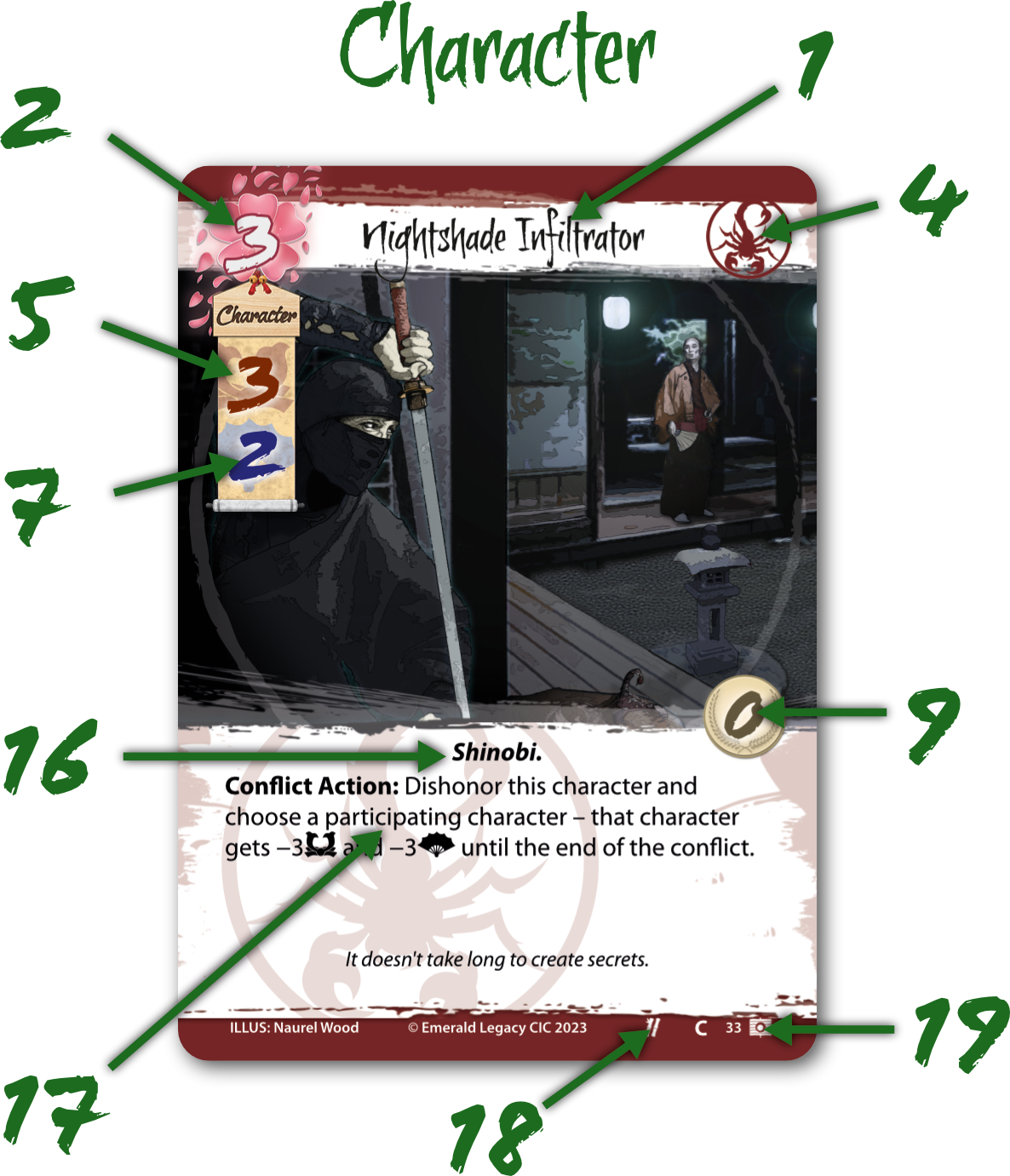
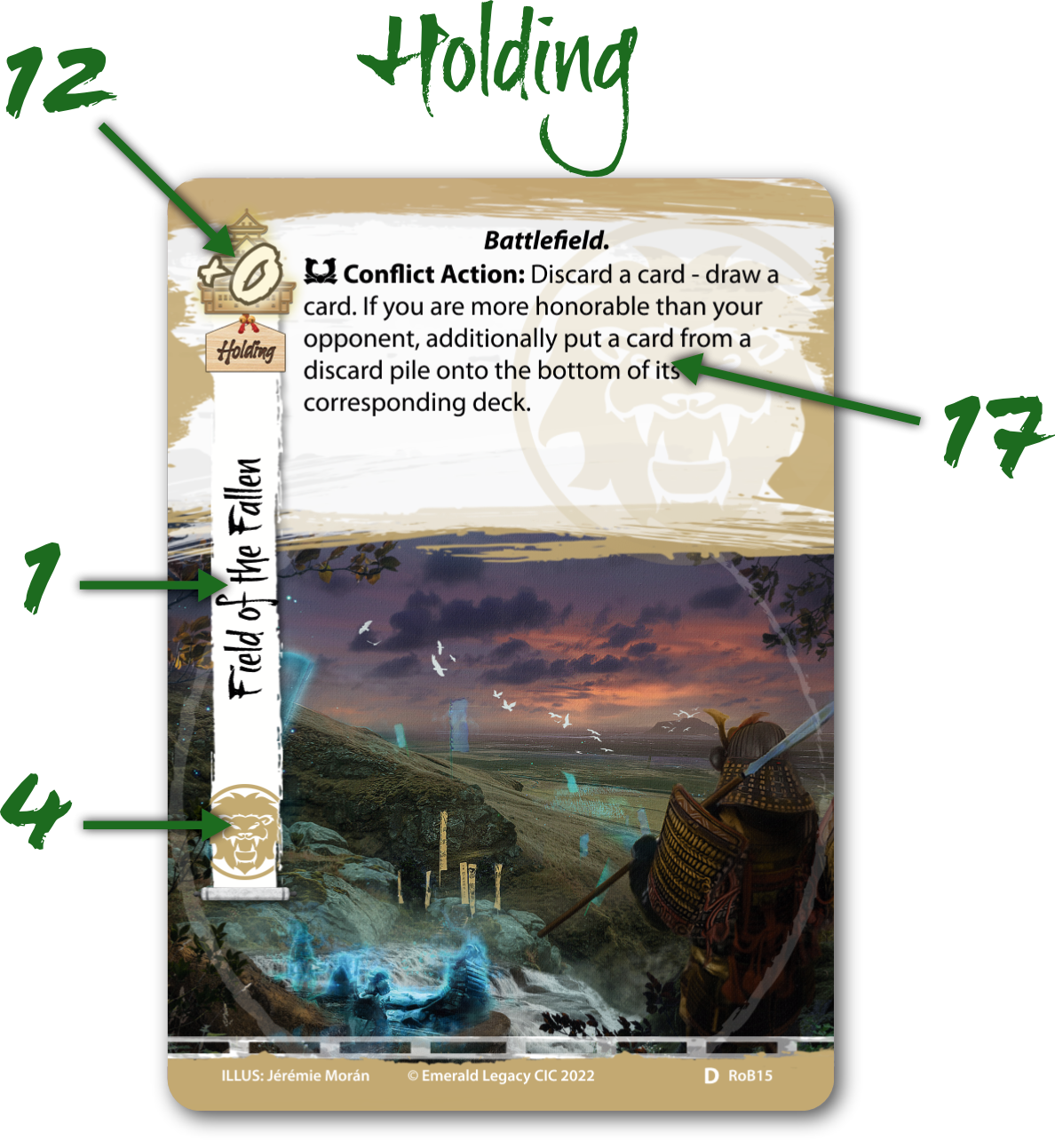
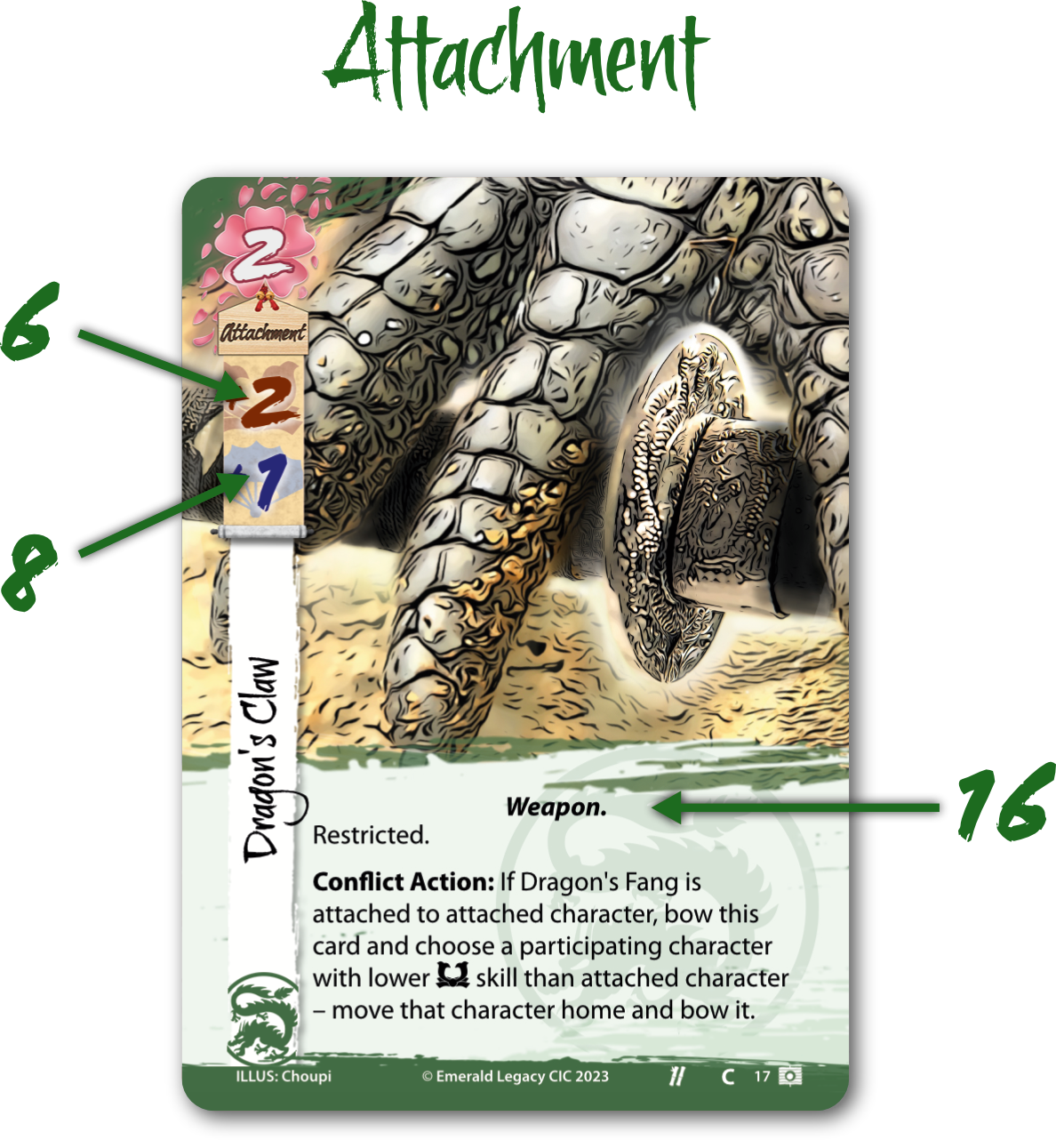
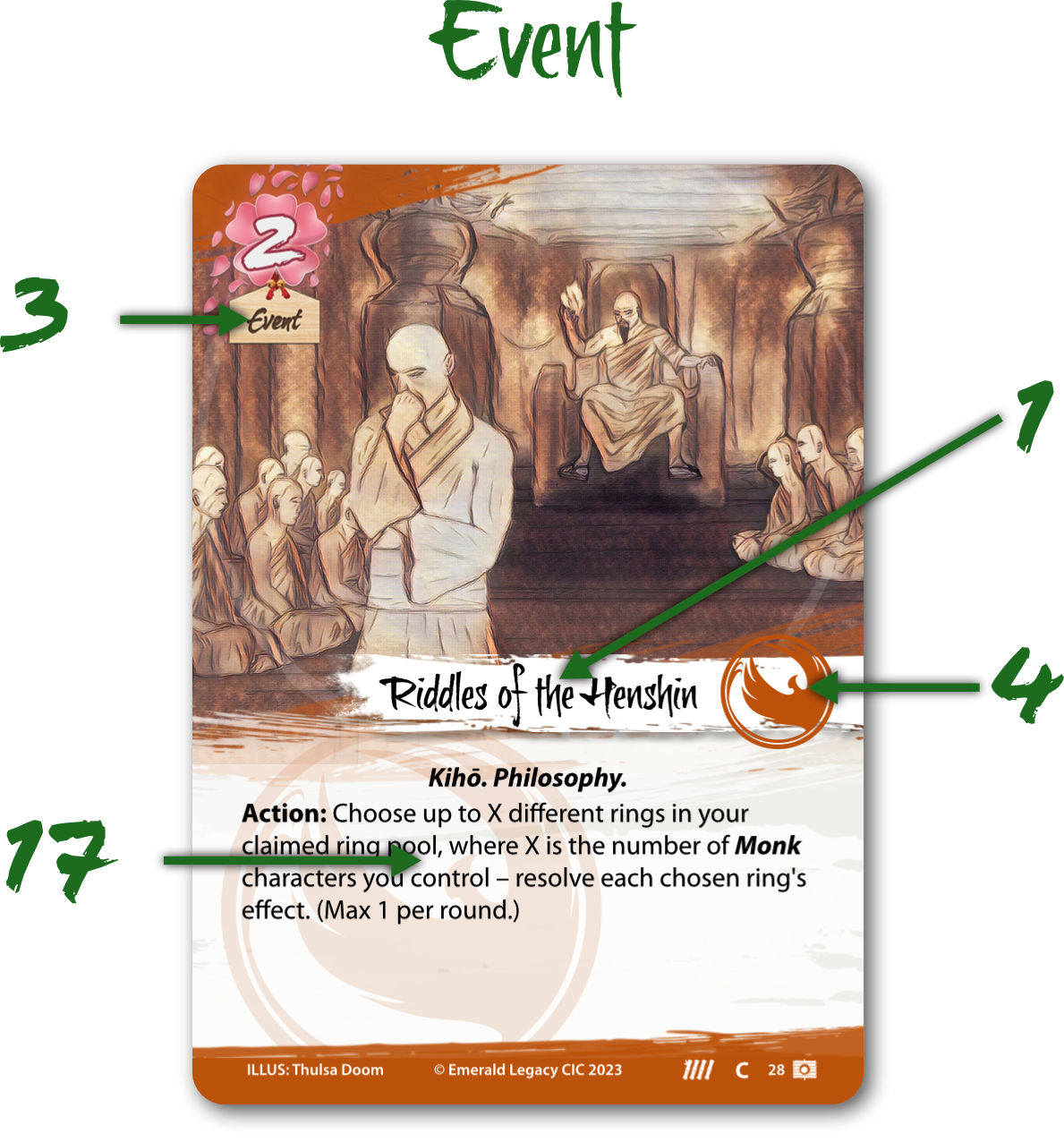
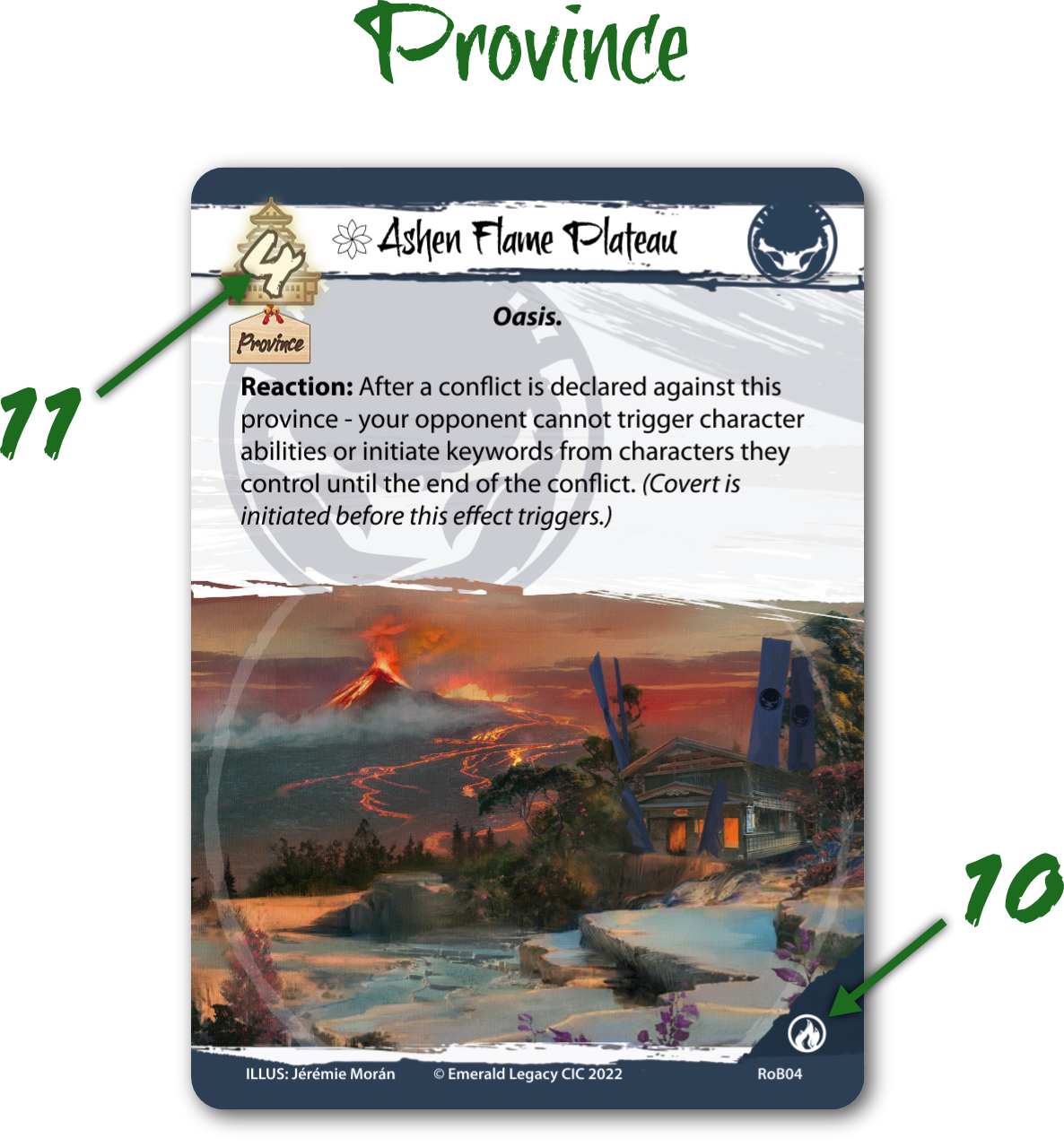
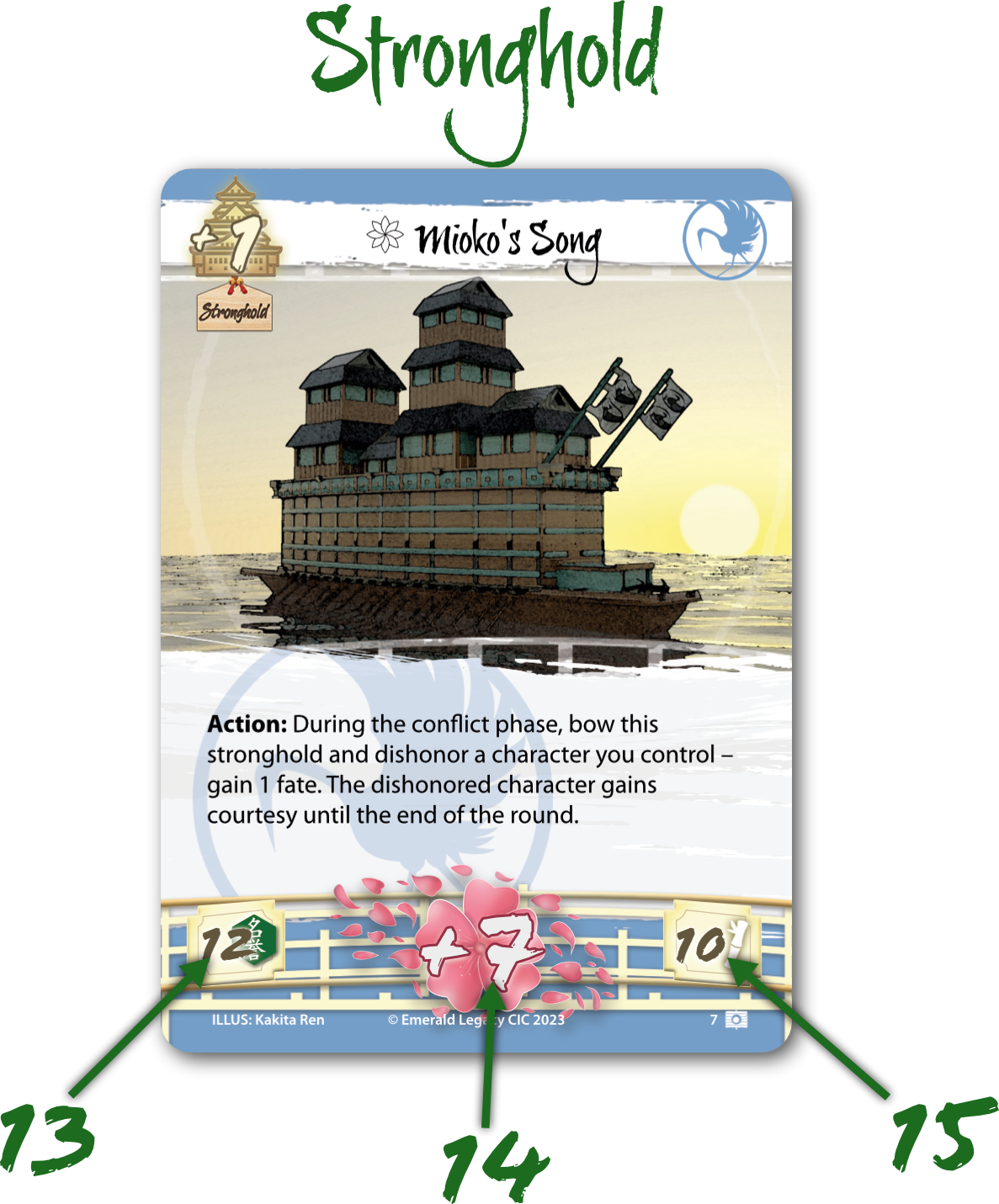
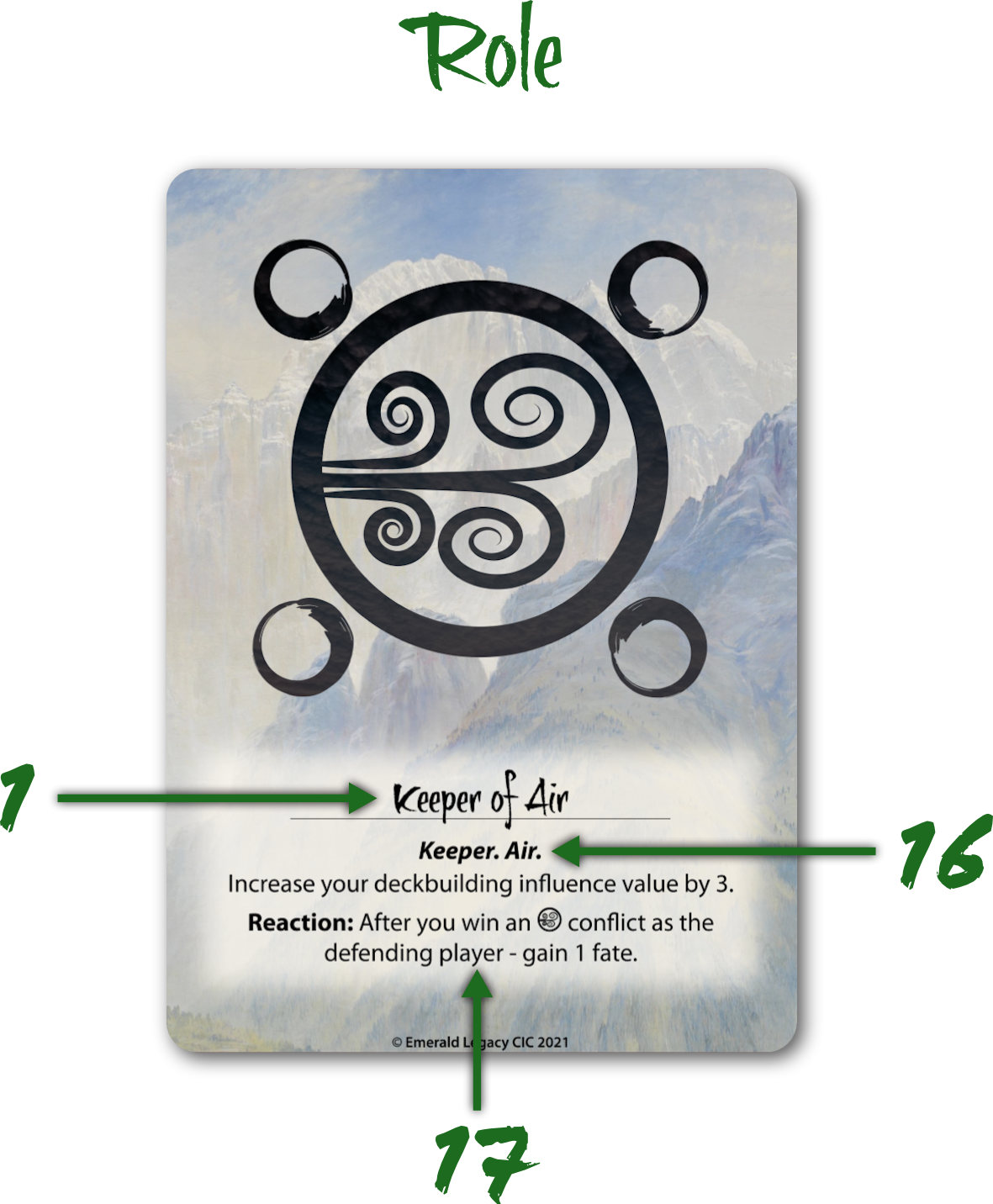
Appendix III: Card Clarifications
This section provides answers to a number of common questions that are asked about cards in the game. These answers are organized by the expansion and collector number of the card whose rules interaction has raised the question.
Emerald Core Set
Above Question (141)
-
If Above Question is played on an opponent’s character, that opponent cannot choose the attached character as a target for their own events.
-
If the attached character is the only participating character controlled by that opponent, Court Games' honoring effect (Core, 206) cannot be selected, as the attached character cannot be chosen as a target.
-
Waning Hostilities (100)
-
Waning Hostilities limits each player to one conflict opportunity for the phase. Because Waning Hostilities sets a hard limit, no amount of additional conflicts gained through card effects can allow players to declare more than one conflict in that phase.
Disciples of the Void
Secluded Shrine (12)
-
The ring chosen for Secluded Shrine’s effect can be in multiple states at once. For example, while unclaimed, the chosen ring simultaneously counts as being in both the unclaimed ring pool and in your claimed ring pool.
-
You cannot move the chosen ring out of your claimed ring pool due to the cost or effect of a card ability unless the physical ring token is in your claimed ring pool. Warriors of the Wind
-
Agasha Taiko (14)
-
The province that is chosen by Agasha Taiko’s ability cannot be declared as the attacked province and the conflict cannot be moved to it.
-
If Agasha Taiko is played during a conflict and chooses the currently attacked province for her ability, the conflict immediately ends with no winner and all participating characters are moved home bowed. Masters of the Court
-
Maker of Keepsakes (7)
-
If a character "cannot receive dishonored status tokens," then those tokens cannot be placed on or moved to that character. That character cannot be dishonored if it is ordinary. Seekers of Wisdom
Dragon Tattoo (23)
-
After you play an interrupt or reaction event that targets a character with Dragon Tattoo attached, the tattoo can be used to play that event again. The interrupt or reaction event is played during the interrupt/reaction window that the card was originally played in.
-
When an interrupt or reaction is played in this way, it is "queued" into the appropriate interrupt/reaction window, but is not actually played until the reaction window for playing the original event closes. Therefore, cards like Watch Commander (Core, 133) will trigger after the first instance of the event but before the second instance of the event—this is different from when Dragon Tattoo plays an action event, as an Action event (such as Hurricane Punch (Elemental Cycle, 17)) is fully played and resolved within the resolution of Dragon Tattoo’s ability.
-
Elemental Cycle
The Mirror’s Gaze (15)
-
The Mirror’s Gaze cannot be used to copy interrupts or reactions whose effects cancel a card effect or framework step.
-
The following cards are some examples of some events that cannot be copied by this attachment for this reason: Voice of Honor (Core, 145), Display of Power (Core, 179), Forged Edict (Core, 184), Censure (Imperial Cycle, 60)
-
-
The Mirror’s Gaze cannot be used to copy events whose effects reference their triggering conditions (which are ignored).
-
The following cards are some examples of some events that cannot be copied by this attachment for this reason: Indomitable Will (Core, 158), Ready for Battle (Core, 165), I Can Swim (Core, 187), Way of the Chrysanthemum (Imperial Cycle, 80)
-
Master Alchemist (44)
-
Master Alchemist can be used to place fate on the ring while it is contested or claimed. Fate will stay on rings up until the point at which they become contested. If the ring is already being contested when fate is added to it, the attacker will not gain that fate.
Children of the Empire
Kakita Toshimoko (14)
-
If a participating character’s skill values are dependent upon players' honor bids, Kakita Toshimoko’s interrupt ability can alter the calculation of skill totals in step 3.2.3 before fully resolving that step by changing those players' bids and potentially changing which player wins or loses the conflict due to the change in skill values.
-
Because interrupts resolve before their triggering condition (page 11), and because "would" effects have the capability to change the triggering condition (page 20), Toshimoko’s ability has the potential to change the outcome of step 3.2.3. Therefore, if: a character’s skill values are dependent upon the players' honor bids, Toshimoko’s duel changes those bids, and he loses the duel, then it is possible that Toshimoko could lose the duel but win the conflict (if up against a Sincere Challenger (Children of the Empire, 27) who loses composure in a political conflict, for example, or by being honored by Kyūden Kakita (Masters of the Court, 1)). It is also possible that recalculating skill values for step 3.2.3 due to Toshimoko’s ability could cause a province that would originally be breaking to no longer be breaking if the loss of skill (or increase of Toshimoko’s skill) causes the attacking player to not have the excess skill necessary to cause the province to break.
-
Unmatched Expertise (65)
-
If a character "cannot receive dishonored status tokens," then those tokens cannot be placed on or moved to that character. That character cannot be dishonored if it is ordinary. (See page 32.)
Inheritance Cycle
Command Respect (18)
-
When an event card is played, it is considered to still be in its owner’s hand while determining whether a card’s play restrictions are met. Command Respect cannot be played if both players have the same number of cards in hand.
Akodo Kaede (28)
-
Akodo Kaede’s effect can prevent a character from being sacrificed. (See Reprieve, page 29)
Steward of the Rich Frog (54)
-
When an event card is played, it is considered to still be in its owner’s hand until after all costs and selections have been made.
-
While choosing targets during Step 5 of the process of playing For Shame (Core, 207) on a Steward of the Rich Frog, the Steward’s text prevents characters from receiving dishonored status tokens. Because selecting options happens during the same step as choosing targets, the For Shame is still in the opponent’s hand when the selection is made, and an option whose effect would fail to change the game state cannot be selected.
-
-
If a character "cannot receive dishonored status tokens," then those tokens cannot be placed on or moved to that character. That character cannot be dishonored if it is ordinary.
Dominion Cycle
Seven Stings Keep (25)
-
When resolving this stronghold’s ability, the process of declaring a conflict is inverted. The conflict begins with the declaration of defenders, which means the defending characters will be participating in the conflict before the attacking characters are declared (and before there is an attacked province, a conflict type, or a contested ring). Because there is no conflict type when defenders are declared, any character may be declared as a defender. If the conflict type chosen by the attacking player would result in an ineligible defender—for example, because the defender has a dash skill value for the declared conflict type—then that character moves home bowed.
-
When declaring attackers, the attacking player must choose a number of attacking characters equal to the number chosen when paying the cost of Seven Stings Keep’s ability. If a number was chosen greater than the number of eligible attackers, the attacking player must declare the greatest number of possible attackers. This may force the attacking player to select a particular ring or conflict type to make the declaration of the required number of attackers eligible. For example, if a character has a dash skill value, and it must be declared to reach the chosen number of attackers, then a conflict must be declared.
Retire to the Brotherhood (28)
-
If a player reveals their entire deck and does not reveal a number of characters equal to the number of characters they discarded to this province’s effect, they do not reshuffle their discard pile to keep revealing more cards. They only put into play the characters revealed, even though this results in fewer characters entering play than the number of characters that were discarded.
-
If a player reveals multiple copies of a unique character to this province’s effect, or reveals a unique character already in play that they own or control, they do not put the duplicate(s) into play. They do not reveal or put into play any additional characters to make up for the unique characters that could not enter play.
Silent Ones Monastery (50)
-
When a player would gain more than 2 honor per phase due to honor being transferred between players, such as by an honor bid, the Silent Ones Monastery prevents all but 2 of it. The honor is not lost by the player giving honor because it is not gained by the player who would be gaining honor.
Study the Natural World (68)
-
The effect of this event adds the element(s) of the attacked province to the contested ring immediately and creates a delayed effect that allows the attacking player to resolve each of the contested ring’s effects if they win the conflict. This delayed effect occurs during step 3.2.3 of conflict resolution, at which point the attacking player may either resolve all of the contested ring’s effects or none of them. It does not replace framework step 3.2.6, when the attacking player may also resolve [b]one[/b] of the contested ring’s effects as normal.
Under Siege (89)
-
If the defending player has no cards in their hand, this card cannot be played.as normal.
Foothills Keep (94)
-
When paying the additional cost for attacking a province other than Foothills Keep, fate cannot be spent to the ring selected to be the contested ring as the conflict is declared.
Contested Countryside (106)
-
All ability limits are player-specific, so this holding allows the attacking player to trigger the attacked province’s abilities, even if the defending player also triggers those abilities.
Divine Ancestry (110)
-
If you cannot lose honor, you cannot give honor to an opponent (and they cannot take honor from you). Any card effect or framework step that would require the transfer of honor is ignored.
Compromised Secrets (135)
-
If the attached character has a forced ability, that ability gains the additional cost of giving the opponent 1 honor. Because the ability is forced, it must be triggered and therefore the costs (giving the opponent 1 honor) must be paid.
-
If Compromised Secrets and the character it is attached to are both controlled by the same player, the additional cost to trigger the character’s abilities would require a player to give themselves 1 honor. Because a player cannot give themselves 1 honor, the additional cost cannot be paid, and therefore the abilities cannot be triggered.
Through The Mists
Lucky Coin (11)
-
During conflicts, Lucky Coin only disables the effects of dishonored status tokens. The character is still dishonored. However, it doesn’t subtract its glory from its skills and its controller doesn’t lose honor when it leaves play (during a conflict).
Pride (19) and Noble Vanguard (21)
-
The attachments created by Pride and Noble Vanguard have no name, therefore the attachment limit does not apply. This means that multiple of these attachments can be attached to the same character.
Cherished Family Servant (36)
-
Cherished Family Servant enters play under the control of your opponent. Therefore, the Dire ability on Cherished Family Servant applies its effect to Poison attachments attached to your opponent’s characters as effects always apply to the controller of a card, unless otherwise specified.
Appendix IV: Card Errata
This section contains the official errata that have been made on individual cards in Legend of the Five Rings: The Card Game. Errata overrides the originally printed information on the card it applies to. Unless errata for a card appears below, the original English printing of that card and all of its information is considered accurate, and overrides all other printings. This includes translated cards, promotional cards, and printings which may appear in alternate products.
Kyūden Isawa (Disciples of the Void, 1)
Should read: "During a conflict, bow this stronghold and discard a
Spell event from your hand"
(Added "and discard a Spell event from your hand")
Kaito Kosori (Disciples of the Void, 18)
Should read: "During each [Air] conflict, if you control at least 1
participating character and if this character is in your home area
and ready, it contributes its skill to your side."
(Added "and ready.")
Yogo Kikuyo (Disciples of the Void, 25)
Should read: "When the effects of a Spell event your opponent
plays during a conflict would initiate, put this character into play
from your hand - cancel its effects."
(Added "from your hand.")
Daidoji Uji (Masters of the Court, 11)
Should read: "While this character is honored, you may play each
character in your provinces as if it were in your hand."
(Removed "reducing its cost by 1.")
Those Who Serve (The Emperor’s Legion, 28)
Should read: "(to a minimum of 1)."
(Replaces "(to a minimum of 0).")
Kaiu Shihobu (Defenders of Rokugan, 10)
Should read: "Put a facedown holding under your stronghold
province into play in an unbroken non-stronghold province…"
(Replaces "Put a facedown holding under your stronghold
province into an unbroken non-stronghold province…")
Hawk Tattoo (Elemental Cycle, 75)
Should read: "Attach to a character you control."
(Added "Attach to a character you control.")
Stay Your Hand (Children of the Empire, 80)
Should read: "When a duel that targets a character you control
would resolve"
(Replaces "When an opponent initiates a duel that targets a
character you control")
Butcher of the Fallen (Dominion Cycle, 31)
Should read: "While this character is attacking, characters with
less skill than the number of unbroken provinces you control
cannot be declared as defenders."
(Replaces "While this character is attacking, characters with
printed skill X or less cannot be declared as defenders, where X
is the number of unbroken provinces you control.")
Stoke Insurrection (Dominion Cycle, 113)
Should read: "During a conflict - reveal each facedown card in
your opponent’s provinces. Then, put up to 2 characters with
total printed cost 6 or lower from their provinces into play…"
(Replaces "While this character is attacking, characters with
printed skill X or less cannot be declared as defenders, where X is
the number of unbroken provinces you control.")
Unbridled Ambition (Dominion Cycle, 116)
Should read: "Cannot be a stronghold province."
(Added "Cannot be a stronghold province.")
Shosuro Deceiver (Temptations Cycle, 96)
Should read: "While this character is participating in a conflict it
gains each triggered ability on each other participating
dishonored character except for abilities granted by instances of
this ability."
(Added "except for abilities granted by instances of this ability.")
Spell Scroll (Under Fu Leng’s Shadow, 109)
Removed "Item" trait.
Reprint Changes
The following errata clarifies the interaction between individual card text and the rules in this document, based on the current card ability templating. These text changes will be reflected in any future printing of the card, whether in reprints of existing product, promotional printings, and new printings in future products.
Prononuns (All cards)
All instances of "he or she" that appear on existing cards will be reprinted with the singular "they" pronoun.
"As if you were the attacking player" (All cards)
All instances of the phrase "as if you were the attacking player" printed on cards that resolve ring effects will be removed on future reprints.
"Initiate a [type] duel" (Characters and attachments)
All instances of the phrase "initiate a [type] duel" printed on character and attachment cards should read: "this character initiates a [type] duel."
Kitsuki Shomon (Underhand of the Emperor, 13)
Should read: "If you do, ready this character."
(Replaces "Then, ready this character")
The Spear Rushes Forth (Masters of the Court, 23)
Should read: "discard an honored status token"
(Replaces "discard an honor token")
Prepare for War (The Emperor’s Legion, 25)
Should read: "Then, if that character is a Commander…"
(Added "Then,")
Hida Sukune (Defenders of Rokugan, 5)
Should read: "draw 1 card, then discard 1 card from your hand.
(Limit once per conflict.)"
(Replaces "draw 1 card and discard 1 card from your hand. (Limit
once per conflict.)")
River of the Last Stand (Defenders of Rokugan, 14)
Should read: "your opponent discards 2 random cards from their
hand, then draws 1 card."
(Replaces "your opponent discards 2 random cards from his or her
hand and draws 1 card.")
Oracle of Stone (Elemental Cycle, 37)
Should read: "Then, each player discards 2 cards from his or her
hand."
(Added "from his or her hand.")
Ikebana Artisan (Elemental Cycle, 63)
The text after the dash should read: "cancel that honor loss. Then,
lose 1 fate. (Unlimited.)"
(Replaces "lose 1 fate instead. (Unlimited.)")
Hidden Moon Dojo (Elemental Cycle, 68)
The title should be spelled Hidden Moon Dōjō.
Should have the Dōjō trait.
(Updated the spelling of the title and trait.)
Mantra of Earth (Elemental Cycle, 116)
Should read: "opponents' card abilities cannot choose that
character as a target."
(Replaces "opponents' card effects cannot target that character.")
Paragon of Grace (Children of the Empire, 13)
Should read: "During a conflict in which this character is
participating on your side alone"
(Added "on your side")
Sage of Gisei Toshi (Children of the Empire, 28)
Should read: "If you do, move that character home."
(Replaces "Then, move that character home.")
Hand to Hand (Children of the Empire, 13)
Should read: "If you do, move that character home."
(Replaces "Then, move that character home.")
Unmatched Expertise (Children of the Empire, 65)
Should read: "Attached character cannot receive dishonored
status tokens."
(Replaces "Attached character cannot become dishonored.")
Ide Ryōma (Inheritance Cycle, 79)
Should read: "If you do, ready the other."
(Replaces "Then, ready the other.")
Regal Bearing (Inheritance Cycle, 84)
Should read: "Set the bid on your honor dial to 1. Then, draw
cards…"
(Replaces "Set the bid on your honor dial to 1 and draw cards…")
Expert Interpreter (Clan War, 45)
Should read: "during each conflict in which one of the chosen
rings is contested this phase…"
(Added "this phase")
Spectral Visitation (Dominion Cycle, 68)
Should read: "After this province is revealed - discard the top 4
cards of your dynasty deck. Then, choose a character in your
dynasty discard pile and put that character into play."
(Moved the phrase "Discard the top 4 cards of your dynasty deck.
Then, discard the choose a character in your dynasty discard pile"
from before the dash to after the dash.)
Study the Natural World (Dominion Cycle, 68)
Should read: "the contested ring gains each of the attacked
province’s elements until the end of the conflict."
(Added "until the end of the conflict")
Exposed Courtyard (Dominion Cycle, 122)
Should read: "During a conflict - discard the top 2 cards of
your conflict deck. Then, choose an event in your discard pile. You
may play…"
(Moved the phrase "Discard the top 2 cards of your conflict deck.
Then, choose an event in your conflict discard pile" from before
the dash to after the dash.)